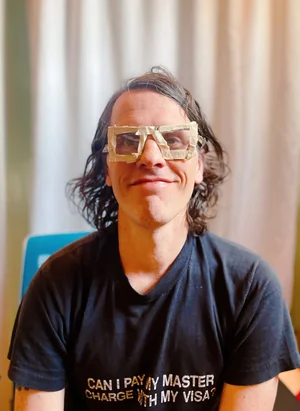
Episode 7: Ian Lee
Josh Caldwell: So this happened 19 years ago and this person's still around. So that means that person knows where the bodies are buried, for lack of better words, and is not telling anybody and only told this to other people who know where the bodies are buried.
Josh Caldwell: Welcome to Atypical Daydream, a podcast about life on the road. I'm Josh, your host, and thanks for stopping by. My guest today is Ian Lee. He's both a drummer and a songwriter, but he also owns a tour bus company. He drives the bands all over this US. Ian has two stories for us today. The first finds human connection through the necessities of tour life. And the second somehow leaves you wanting more while still being pretty satisfying.
Ian Lee: Yeah, so I had a band that was a big Led Zeppelin tribute band. So I put on a wig and played John Bonham. The band was called Led Zeppelin II and we did really good. And then we were touring pretty heavily. So I bought a bus for that band thinking that the band would rent the bus for me and that would put some more money in my pocket. And then I started getting enjoyment out of touring with other bands. The idea was that in between the Led Zeppelin band's tours, we would rent the bus out or take other bands out. I started getting more pleasure out of that.
I felt that it was a way that I could carve out a living for myself that I could kind of control. That was my — I wouldn't say my first mistake, but first in a line of many mistakes. My day starts at typically about two o'clock in the morning. I go to bed at four o'clock in the afternoon and then sleep until midnight in a hotel. And then I take an Uber back to a venue and pick up a band who's just come off stage and packed all their stuff. Drive them from Chicago to Detroit and then from Detroit to, you know, on and on it goes. About 12,000 miles is a loop around the country.
I have a secret parking spot in an undisclosed location in Chicago. It's in a sketchy area to say the least — this industrial area. There's usually a cop that parks kind of under these train tracks and they don't hassle you. There's enough industrial stuff that there's no houses or anything like that and nobody kind of messes with you. So when we're on tour, instead of paying for a hotel every night, we just crash on the bus.
When you're on tour, every show — let's say you've got 15 shows — every night, part of your contract is that the venue has to provide a cheese and meat tray and three bags of tortillas and hummus and two cases of water and a case of beer. And whatever's left over in the course of the day makes its way onto the bus. Nobody leaves booze behind. So every day you end up with one bottle that gets stashed in a drawer, or leftovers.
So the last show will say is in Detroit and then they're from England. So they get out and they play Detroit and then they jump on a plane and all of the stuff — all the food and booze they have leftover — is left behind on the bus for me to deal with.
There's this homeless guy that I'd always see there and he came up to the bus one day and knocked on the door. He said, hey man, I see you guys crashing here. I go, we got rock bands and stuff and the cops don't hassle us. He's like, I live under that bridge down there. How about when you take off — I see you leaving every day to go get some food and stuff — how about you give me 20 bucks and I keep an eye on your bus? I'm like, that's a done deal, we'll do it. So every time we'd leave, we'd slide him 20 bucks and he'd keep an eye on the bus.
I keep thinking his name was like Kevin or something. I kind of knew his name at once, but we were just kind of like friends with this homeless guy. So what happened was, I ended this one tour and I had easily a thousand dollars worth of liquor. It was cold out and I saw the guy and I was cleaning the bus up and he knocks on the door. I go, hey man, yeah, we're gonna be here for a couple days, here's 20 bucks. And I look over and I see — what am I gonna do with this thousand dollars worth of liquor? I was at a crossroads. He's down on his luck, he's having a hard time. Is this gonna help his situation or is this gonna medicate him?
And I just said, can I ask you a funny question? He said, what's up? And I said, do you drink?
Ian Lee: And he goes, come on, man. I go, listen, I see that you got a little setup down there. If I give you some booze, would it help you get through the thing? He's like, yeah, man, bring it on. So I moved $1,000 worth of booze into my homeless friend's little refrigerator box home.
And that went on, I think, for about two years. I would kind of try to mediate it where I'd try to give booze away to other people we'd see on the road. But I always got in the habit of keeping something good for him. I think at one point he said he liked scotch or something like that. So I made sure I always had a bottle of Maker's Mark or some good whiskey for him. And I haven't seen the guy in a few years and I don't know anybody else in that area. Nobody's ever come up and said, hey, you know, he got back on his feet or he passed away or whatever. It's just funny, these people that kind of cross paths. And this is all because I needed a place to park and I had more booze than I knew what to do with.
Josh Caldwell: Hey, Josh here. I love making this podcast and I'd love to make it my full-time gig. Besides telling the stories, I'm basically a one-man van and that takes time. If you're enjoying the podcast, please consider becoming a patron. You'll have access to loads of great bonus stories and you'll have the satisfaction of knowing that you're supporting a truly independent podcast. Find the Patreon link in the show notes. And thanks.
You know, when people ask what you do for a living, usually most musicians say, well, we drive through the night and we look for a place to take a shit because rule number one on a tour bus is no number two. And the main reason for that is if you can imagine 12 people having to poop into a tank that can only get emptied once in a while, it tends to back up and it's really bad. That's why it's rule number one and nobody violates it. I've never had anyone violate it actually in nine years. So fingers crossed that that continues.
It's not glamorous. The main point is nothing that I'm saying is glamorous. And if you think being in a rock band and touring is glamorous, you've watched too much MTV or you've believed the hype. There's nothing about it that's glamorous. It's working 24 hours a day for about 90 minutes of work. It's just basically all downtime and driving and sleeping and trying to find decent food. The crew people kind of tend to jump around. When you meet your crew or your band or whatever, there's a lot of, I know that guy, I just got off tour with him. So there's a lot of that.
And there's a level of discretion in the inner circle of people who were there. There are things that happen in public that become part of the folklore of rock and roll. Stories get embellished and as they get passed along, you don't really have anybody who was actually there. There's no point in correcting it. But the people who are in the touring business — we're the guys that know. We were there when it actually happened.
Ian Lee: So I'm going to read this from Wikipedia, because this is considered what's true. Wikipedia says that on August 8th, 2004, a bus belonging to the Dave Matthews Band dumped an estimated 800 pounds of human waste from the bus's blackwater tank through the Kinsey Street Bridge in Chicago onto the passenger sightseeing boat, Chicago's Little Lady, sailing in the Chicago River below.
How they measured that there was 800 pounds of human waste in this tank — complete speculation. But rule number one, no number two on the bus. So it was definitely pee only. A bus belonging to the Dave Matthews Band dumped an estimated 800 pounds. I can guarantee that Dave Matthews did not own his own bus. So that's a falsehood or an assumption on this Wikipedia page. Dave Matthews was leasing a bus from a bus company and that bus company provided a driver. And the driver made that decision to empty the tanks. That had nothing to do with Dave Matthews.
Dave Matthews did not walk up to the driver and say, I need you to empty the tanks right now because we're on the bridge over the Kennedy. But this is the only area where there's a fact. As part of the legal settlement, the band agreed to pay $200,000 to environmental protection and other projects. The band also donated $100,000 to two groups that protect the river and the surrounding areas. The band's bus driver, Stefan Wohl, pleaded guilty to dumping the waste in April 2005.
So I was on a tour this last summer, and I'm going to try to not name names, but I was with a guy who works with a lot of big bands and is a person that I've done a lot of tours with. He's one of my favorite people. And he was on a tour with another guy that he claims is absolutely reliable — your bullshit meter is usually pretty high if you're in the entertainment industry, and this is not a bullshitter. He was telling us on the bus.
We started talking about this Dave Matthews story and he said that he just got off a tour with a guy who was one of the 12 people that were on the bus that dumped the tanks. And his story was that it was not Dave Matthews' bus. The fact is that Dave Matthews paid the fine and took the hit. And the artist that was actually on the bus was controversial — under some degree of media scrutiny around that time, considered divisive in some circles. Dave Matthews, on the other hand — college rock, middle of the road, safe, nice guy. Pretty uncontroversial.
According to this source who claims to have been there — and I'm only forwarding this because I would consider it a valid and reliable source — Dave did this to help out and make sure no further controversy or harm came to that particular artist.
I think that's about all I can say about it without giving away any other hints. And if you're a crew guy, if you're one of the other 11 people involved in the story, you can leave a note in the comment section or DM Josh and he'll get a hold of me.
Josh Caldwell: So this happened 19 years ago and this person's still around. So that means that person knows where the bodies are buried, for lack of better words, and is not telling anybody and only told this to other people who know where the bodies are buried.
Josh Caldwell: I want to thank Ian for sharing his experiences. Make sure to check out his band, The Cle Elum, and their new single, I Am A Robot. You can also find Ian at thebestdrummerintheworld.com. And if you're in need of a tour bus, Affordable Tour Solutions is the answer. This podcast was created and produced by me, Josh Caldwell. Music by Visual Aid, my side music project. General support and copywriting by Miranda Caldwell. If you like the show, please follow, subscribe, rate, and review wherever you listen to podcasts. And if you'd like to financially support the show, check out my Patreon page. You'll have access to loads of great bonus stories. You can find the link in the show notes. Thank you for listening, and I hope you come back next week.