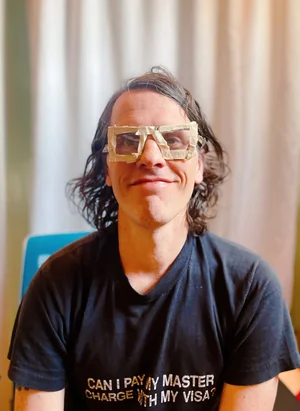
Episode 53: Matthew Roberts
Matthew Roberts: This idea of that travel going from one place to another and wherever you go, there you are. You know, reading about these different places and the magazines and the images. But the idea of, I could do that, I'd like to have a bit of that and to see those different places and how people changed and how they were able to be other than what they were in the nine to five routine.
Josh Caldwell: Hello, my atypical daydreamers, welcome back. It's 2026, which sounds so futuristic to me. I feel like we were promised condos on the moon by now. I want my moon condo. Good news is that I've got some fabulous guests coming your way and some possible collaborations that I'm cooking up for you this year. So stick around. Now, sometimes I meet someone and I think, I've never met a human like this before. My guest today is one of those people. His name is Matthew Roberts. He's a teacher, a student, an academic, and, once upon a time, a tour manager. Not the live band kind, but the kind who guided people on sweeping journeys through Europe. And this makes sense to me because the man has got a way with words. Now all you've got to do is buckle up and enjoy the ride.
Matthew Roberts: We're gonna go right back in time to my own kind of genesis of travel. In a way, when my mom and dad got divorced, I was about seven. So when you'd go one weekend trip to one place and another weekend trip to the other, that kind of liminal space of being in the car and listening to music and learning the different mannerisms, cutlery, routines, rituals in different spaces, learning how to read rooms. All those things were equipping me for a kind of skill set that I then drew on. And as a family, there was a lot of dos. What does a family do? There's a wedding here, there's a baptism here, there's a do down here, someone's got married here. So it was always like going to Manchester or to Birmingham or to Bournemouth.
My roots are firmly in Wales. So as a child we were always going to Penegroes, Dynasynllach, Carnarvon, Bangor, and to be able to walk up Snowdon and to be by the seaside and all those spaces of place and ocean and horizon and imagination. There was the family farm in Nebo, and it was really magical. Sometimes I didn't have to go to the back of the wardrobe to get to Narnia. I was living my real life Alice. I was really giving it some wonderland.
And just for the record, when I was six years old, Mrs. Reimer had been to China and she came back and in primary school she brought dragons. We were all sat there drawing our dragons and I was like, I'm going to go to China. And I did. I ended up teaching in China in 2002, as a volunteer in an economic development zone. We were in Qingdao. That was way before the Beijing Olympics. And it was kind of breathtaking because that kind of travel of going somewhere I'd always imagined, forget Enter the Dragon, enter Matthew Roberts. It was a dream come true to walk on the Great Wall of China, to be in Beijing, to see the Forbidden City, to see the Shaolin Temple. I learned a lot about martial arts in Birkenhead.
But this idea of that travel, going from one place to another, and wherever you go, there you are. Reading about these different places in the magazines and the images. But the idea of, I could do that. I'd like to have a bit of that. To see those different places and how people changed and how they were able to be other than what they were in the nine to five routine. And that was always really inspiring.
Matthew Roberts: One of my first jobs when I finished my A levels, I flew out from Manchester at 18 to work abroad in the Canary Islands. I had eight weeks in the Canaries. There's your hotel, go and run it. And then I went back and did my first year of my degree. And then in the second year, I went back to the same island in Gran Canaria, but I wasn't in Playa del Inglés, I was in Puerto Rico. That was incredible. And this is like late nineties. This is like when the garage scene was about.
You could see in terms of the social engineering of these different islands, people could identify. You had the northerner, you had the Scot, you had the Welsh, you had the southerner. And it was kind of extraordinary. This gathering of Britain on one side to this liminal space of Britain on the other side with the sunshine and how that changed people's status, the idea of leisure and pleasure. And as a kid, we'd been to somewhere like Butlin's, holiday camps that were formed by Billy Butlin after the Second World War. Originally those spaces were used to train the military.
The commonality here, the thread here, is about family. It's about connecting with others and people. When I finished that particular chapter of my life and got a degree, I went back to work in Tenerife. I was never able to afford, I was working class, I still am working class, but the idea I couldn't afford to go to these places but I could go and work there. That's always been an interesting tension in my life. And this is where kindness is kindness is kindness, and chaos is chaos is chaos, be that in the hut of a chalet or a five-star resort. It's very interesting to see how people have got grace and class in all different kinds of circumstances.
Matthew Roberts: And this idea, I would always like to go to Europe. So from Tenerife I was thinking about going to Europe. There was a company from the sixties that originated in New Zealand, originally traveling in a minivan, and it grew and it grew into an international company. They operated in Europe, Australia, America, Canada. First of all, you are not guaranteed a job. You have to make it through the training. It was an eight-week boot camp on a coach, almost like social, economic, political history, economic history, the geography of all these different places. Because you go from London to Paris to Beaujolais down to Fontainebleau and then you go to Barcelona, back into Antibes, Nice and Cannes, up to Monaco, back down, and then you'd go zooming around Italy, Florence, San Gimignano, and right the way down to Rome. Then you might go down to Brindisi, hop on the ferry for four days in Corfu, and then jump back up to Venice. Incredible, breathtaking.
Arriving in Venice, you'd have your CDs back then. It's just you, the driver, and your 52 people. And it was kind of like, Vangelis is always good for transcending down. Or you'd have your morning song to get everyone on the coach, here we go. And then you'd have your service stop song. So it was just like Pavlov's dog theory. Been on the coach for two hours, do do do, off you go. All these things were instrumental in terms of how you connect with people and how routines can happen. I learned that with a good soundtrack there was this moment from here to here, and timing for those different musical moments, how you could influence the mood and atmosphere. And that was extremely powerful.
But also on a very serious note, I was able to go to Dachau and to Mauthausen several times. And I always would say, hath not a Jew eyes, organs, dimensions? You prick us, do we not bleed? If you tickle us, do we not laugh? This idea of humanity in those inhumane places.
Matthew Roberts: And it was always very moving. I think the call in all of these things is about our collective humanity, about our connection. There are no birds that sing over Mauthausen. And so from moving out of that, I always remember we played Phil Collins, Another Day in Paradise, because that opening was just incredible. It's a wave. And you would just give people space to be on the coach.
And I think that moment when we are traveling, be it with our head on the glass on a train or head on the glass on a car, or even that moment of freedom driving along in an open-top Jeep in Cyprus, the sun beating down with a bandana on. Just glorious.
I remember as a kid being in a newsagent reading books and at fourteen there was a copy of Seven Habits of Highly Effective People and I was like, I love a bit of that. And in that book, Stephen Covey had a quote from T.S. Eliot. We must not cease from exploration. And the end of all our exploring is to arrive where we began and know the place for the first time. And that was touring around Europe. That was going back and to different parents, going back and to different family we've not seen. Haven't you grown? We change and we change in each other's eyes in size and shape, in maturity. And that was really profound.
And I think that idea of traveling, as we go out to these spaces, we do connect with a fundamental core within ourselves. A sense of being, a sense of awe, a sense of wonder. I'll never forget, I like a bit of Confucius, and I remember walking around Confucius' graveyard in China, and the size of these gravestones, these epic massive enigmatic stone creatures that through the mist became visible. Those moments that take your breath away.
Matthew Roberts: The idea of return. Going back recently, I did climb Snowdon again in October. I got COVID really bad. I was horizontal for about ten weeks. And it was on my bucket list. I'd really like to get to Snowdon again, to climb that mountain. And it was a beautiful day. Respect the mountain. People going up there in flip flops, respect the mountain.
The Camino Santiago, I'd like to have a go at that. Because I remember as a tour manager, come on, ABC, another bloody church. And it was, when we talk about constellations and joining the dots up. Remember when we saw that archangel St. Michael in Paris, and here we are in Munich, and we can see this here. And you could cross-reference. Some people went to parties, some people went for culture. I was giving them social history, political history. And I think there was a real zest in that.
And when we come to stories and we travel in stories, that's the whole thing about being a playwright or a cartwright. We travel, it's a vessel to move through. It's a vessel which we allow to suspend our disbelief and to become other, or to become the people that we're meant to be. And I think the idea of travel, as we journey through something, we can become something better, hopefully not worse, than we were ever meant to be.
Josh Caldwell: I want to thank Matthew for sharing his experience. You can find him on Blue Sky. And if you want to hear more from him about leisure, pleasure, and the British holiday across the centuries, Matthew will be presenting a lecture live and on Zoom at the Society of Antiquaries on Tuesday, January 27th from 1 to 2 p.m. For more information, you can find the link in the show notes. This podcast is created and produced by me, Josh Caldwell. Music by Visual Aid, my side music project. General support and copywriting by Miranda Caldwell. And if you know someone who might enjoy this show, send them this episode. Thank you for listening, and I hope you come back next time.