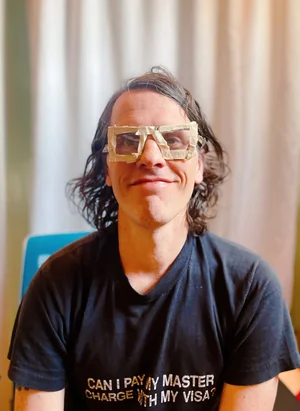
Episode 31: Karthik Nagarajan
Karthik Nagarajan: To me life just feels like one big road trip. So but I've never actually done like this weird road trip or anything like that, you know. So I was always that kid like who would probably drive up from the airport and like watch planes take off and like basically tell myself, yeah, I'm gonna be on one of those.
Josh Caldwell: Hey atypical daydreamers, welcome to the show. My guest today is Karthik Nagarajan. Having recently relocated my family from the United States to Berlin, Germany, I've been drawn to stories of others who have chosen a similar path. Karthik shares his journey of self-realization as a young man in India and offers a unique perspective on building a new life in the United States. A life that feels like an endless road trip.
Karthik Nagarajan: I always had a passion for talking to people from an early age. And a lot of that I think just comes from my upbringing. Because I grew up in the nineties in a small town in India, not so small anymore, called Pune. And you've got to understand that this is like the dawn of globalization in India. India was still very closed in the eighties, almost apprehensive about opening up in a big way because of all the colonial past and all that stuff. So early nineties, I'm a kid growing up in India. A very interesting childhood because I grew up in a very normal in many ways middle class family in my town. My dad had a nine to five job, a five and a half day work week. The very traditional sort of British model.
My family expected me to grow up into something. Do very well in academics, become some sort of computer engineer that makes money, all the typical stuff. On the flip side of that, I grew up five minutes from this ashram. Basically it was this commune that was full of Europeans and Americans. So there was this interesting juxtaposition in my neighborhood between just kids like me and then kids whose parents took the complete opposite approach that my dad would take in life. I don't care about nine to five. I just want to travel and experience life.
This ashram was actually covered in a Netflix documentary called Wild Wild Country. It's the Rajneesh Ashram that came from Portland, Oregon to basically five minutes from where I grew up. And one of my best friends, and he's still my best friend today, lives now in Paris. He's this French guy, Virgil. We just became friends when we were like 12 or 13 because we both liked playing Street Fighter on the Super Nintendo. Not more complicated than that when it first started out. We just hit it off on day one and became friends for life. We still are.
Karthik Nagarajan: Basically, everything my dad would tell me about how success is measured, all the traditional things, as you could imagine. Get educated, go to a prestigious university, be the top of your class, go get some job that pays you a lot of money. That's how you get to success. It's the exact opposite from what my friend Virgil did, the approach he took to life, which is it's all about experience. The nine to five, all that stuff is made up. It was almost like it was fascinating and I think it was very healthy. I think back on that environment in which I grew up and I'm like, that environment was actually very healthy in retrospect. I didn't realize it growing up there.
My friend's dad, to set some context, is very much an artist. Made music, art, wrote books, very creative. Used to be a pretty successful banker in France and just one day decided he was done with that stuff and took a different route to life. And that's kind of how he ended up at the ashram. He never saw me as his son's friend. He just saw me as Karthik. I have very fond memories with both of them growing up. It was just a lot of discovery, curiosity, listening to jazz and ambient music, smoking cigarettes, proofreading his books, helping translate them.
Karthik Nagarajan: MTV came to India in the nineties, early nineties. And the first memory of a music video I ever saw was U2, Even Better Than the Real Thing. It's a very fascinating video, even today if you look at it. And that whole video is basically making fun of one world under TV. They were going through that phase, the Achtung Baby phase where you had these big screens at all their concerts.
I discovered David Bowie and got super into him in addition to all the electronic stuff. And I was very curious about my own sexuality and things like that. I used to cross dress and I was very inspired by his Ziggy Stardust phase. I just thought he was this very unique creature. I had a motorcycle and I had really long hair and I would wear makeup. Not overtly, not to make a statement. It was my own sort of self-actualization in many ways. Because you didn't have social media and all that. You had to discover all these things on your own. It wasn't like somebody was telling you this is how you need to look. It was all done in a somewhat original way.
I actually remember this time when I was at a red light, looking like how I would normally look, in my typical sort of makeup with my hair down and on my motorcycle, and these two really macho looking alpha male types pull up next to me at the red light and they look at me and they're like, hey baby, do you wanna go grab a drink? And I look back at them in the same deep voice and I'm like, yeah, sure, I know a bar two blocks from here. And it's like they'd seen a ghost.
Karthik Nagarajan: They ran through the red light and I never saw them again. But there was no real internet and all this LGBTQ stuff had still to hit, you know. And it was very fringe at the time. When you're in this environment where it's the dawn of a lot of things, you do things in small measures. So it's almost like for a lot of people looking at me, they may just be like, that's a guy. But it's only when these interesting social experiments happen that you realize life is charming in these little doses, in these one-on-one type doses.
Josh Caldwell: Hey, it's Josh. Hope you're enjoying the podcast. And if so, are you wanting more road stories? Well, good news. I've got you covered. Consider becoming a patron. You'll have access to loads of great bonus stories that there just wasn't time for. And you'll be supporting a truly independent podcast. Find the link in the show notes and thanks. Now back to the show.
Karthik Nagarajan: To me, life just feels like one big road trip. So but I've never actually done like this weird road trip or anything like that, you know. So I was always that kid who would probably drive up from the airport and watch planes take off and basically tell myself, yeah, I'm gonna be on one of those. I finally got to a point where my parents could provide for that. I got an undergraduate degree and I finally kind of did it.
I had a couple of options. I could go to Europe, I could look to America, I could look to Australia, Canada, whatever. But I was just influenced by a lot of the art that came out of here. Big fan of a lot of the modern art that came post World War II, and it applies very broadly, to painting, to music, to TV, to movies, all that stuff. So just like many immigrants that come here, I suspect I was pulled in through art and media in some ways. People have been coming here for decades, almost a century, due to some Humphrey Bogart movie they probably saw. But the reality is different. This country is not a Hollywood movie.
The first place I landed in the US was Binghamton, New York, which is a small town in upstate New York. Way smaller than the town I ever grew up in. I did six months at a university called SUNY Binghamton. I got there in January, which is the coldest period there. You're talking about somebody who's never seen snow in his life. I didn't know if my ears were gonna make it through one week because they were turning red every day and I couldn't feel them anymore. I was totally ill-equipped in so many ways.
Karthik Nagarajan: As long as you were within the university perimeter, things seemed kind of normal, but some neighborhoods, I didn't really know what a rough neighborhood was. Early days I just remember I had to do a lot of manual work because I had to pay the rent. So I got a job washing dishes in the school cafeteria. This is not like washing dishes at home or loading the dishwasher at home. These are large commercial dishwashers. It's like working in an assembly line. The dishes come in and you put them through the dishwasher.
I used to work with this one lady who had been doing this for decades. She was just so good at it. They put me on shift with her. I'm new to this country, it's my first job, I wanna be an eager beaver. I don't wanna let anybody down. First two, three weeks I would just go at it, all in. But at the end of three weeks I just got burnt out. Coming up on week four, I am really struggling one evening. And this lady who I worked with, she was very much the quiet type. She had not said one word to me in three weeks. She was an interesting character because I would take the bus back home with her. I would be sitting in my seat on the bus and she would be sitting opposite from me with this thousand mile stare.
Month in, I am really struggling to load this dishwasher. I'm just tired. And she notices that and she just leans over and in a soft voice, she says, just remember the dishes will always keep coming. That's like the best advice I've ever gotten. It didn't lead to anything deeper between us. It's not like she all of a sudden struck up a conversation or anything. But yeah.
Karthik Nagarajan: So I went from the northeast, Yankee Central, to kind of the South but not quite the South. Texas. It was very fascinating living in Texas. I moved there before moving to California. I often find that a lot of folks from India move directly to Northern California because they're well equipped to do tech jobs. They never get that other experience within the country. They don't see the Binghamtons and they don't see the Texases of the world. And so their worldview is very shaped by what's going on here. I feel very grateful that I actually went to upstate New York and then Texas and then San Francisco. I have some sense for what people call flyover states. There's this whole country out there which is incredibly fascinating.
I actually remember somebody asking me, you know, how are those places different? Are the people different? And I was like, yeah, the places are different because the way you live your life is very different. Like in San Francisco I don't even really drive a car anymore. And what people say to me feels different. Texas is more broadly speaking Republican and California, especially Northern California, has this reputation for being the other end of that. But if I dig one level deeper, I actually find that people are not that different. In many ways they're equally ignorant about each other.
I remember some of the folks I hung out with when I was spending time in Houston. They were so different from some of the folks I hang out with here. And I'm very involved in this tech startup community here. I do sales at a very early stage tech startup. It's a certain type of scene. Almost like, I'm building something seminal that's gonna change the world in an incredible way. There is a certain amount of hubris that goes with that. But I don't think people here would completely understand somebody who's very successful in their career in the oil and gas industry and has a stag head outside their office and wears cowboy boots to work. And probably understands the internet as well as anybody here, but might just judge people like that by their surface appearances.
Josh Caldwell: I want to thank Karthik for sharing his experience. Do you know someone who would appreciate today's stories? Why not send them this episode? The support really helps. This podcast is created and produced by me, Josh Caldwell. Music by Visual Aid, my side music project. General support and copywriting by Miranda Caldwell. Thank you for listening. And I hope you come back next time.