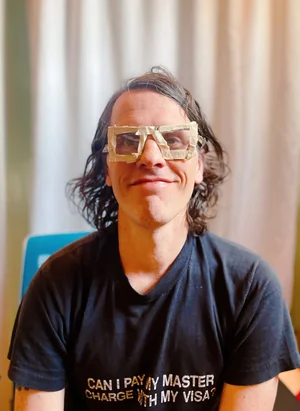
Episode 20: Farmer Dave Scher
Farmer Dave Scher: On the way home, we were in like New Mexico and the tour manager goes, that's it, that's it. Pulls us off the highway, pulls up to a casino and just gets off with his phone and storms away.
Josh Caldwell: Hey, atypical daydreamers, welcome to the podcast. My guest today is Farmer Dave Scher. He's a founding member of one of my all time favorite LA bands, Beachwood Sparks. But it doesn't stop there. Dave has been a part of many marvelous music projects and a session player with some real heavies. Today, Dave takes us on a journey through his life as a well-seasoned musician.
Farmer Dave Scher: The debut Beachwood Sparks album was made by Michael Deming at the Colt Munitions Factory in Hartford, Connecticut. And it had a Russian dome on it that the czar had given as a gift in the 1800s. That was Studio 45. So what the studio would have been credited as. And we had played it. Chris and I had played in the band Lilies. That's a great band. There's definitely a My Bloody Valentine influenced phase. But then we were all into the 60s and he did some really cool stuff. Better Can't Make Your Life Better. That was the album where we were just smitten. So to play in his band was a good nod. And we looked good and we could play.
So my first time on the East Coast was actually playing in Lilies, not Beachwood Sparks, because we had the same drummer, Aaron Spursky. I was definitely a rookie there. There's a funny picture of Chris and I where we just looked like babies. And I remember I was in a bar and I started dancing and the bartender said, hey, there was a sign on the wall. No dancing. Something about cabaret licensing. I didn't know you couldn't dance in New York.
But there was a lot of romance too. Being a young kind of frisky person, there were people who would make out with you. That was good. Then, zooming back to that first album, it went well. For some reason we kind of sound like Care Bears on Helium. We always wonder why we sound like that, but it's a beautiful record and it caught the attention of Chris Robinson from the Black Crowes. I think he just felt like those are his people, which is cool. I could tell you I've had a friendship with him a long time and he loves freaky music. He's a real head. So he had us open for them on a US tour. That would have been our first full-size US tour.
Farmer Dave Scher: And it was big, you know, all those arenas and things. We were set to play the Greek Theater in LA, which was going to be just the total dream. And that was on September 11th. So that show didn't happen. We all met to try to talk about what we were going to do. I had been driving to pick up my dry cleaning that morning. My mom said, pull over. I got to tell you something. You're not playing that show.
So it ended up the Black Crowes told us it's on, we're gonna keep going. Our show September 12th was in Shiprock, New Mexico on Navajo Reservation Land. I think that was one of the first public gatherings where people had played music after 9-11. I was just very touched to be able to meet people from the Navajo Nation. We just met a couple people who were pretty influential, and they would say, you're our brothers. They'd say to us, Yate, N'hamzah. And so that particular show and meeting people from the Navajo Nation was like a real highlight.
Farmer Dave Scher: The Black Crowes had a full touring operation, roadies. And because we were the openers, we dealt with them the most. We made friends amongst them. They'd help us if something broke. They would also haze us. I had traded a childhood 60s Gibson SG guitar for my first pedal steel. And so my lap steel wasn't in as much use because of that, but I had it. I left it one night. And so the Black Crowes touring crew, while I was playing, the audience started laughing. The band started laughing. I didn't know why, but they had attached my lap steel to a rope and lowered it above my head while we were playing as a joke.
So we played at the Bronco Bowl in Texas. Things were a little scarier. Like the whole place was going. In hindsight, for people to have it go the way of being country proud makes sense, but it was a little scary. I think the country was under orange alert. There were signs everywhere. There was a strong mood, shall we say.
And we made it to New York and we were among the first concerts to happen there. September 20th, 2001. When we first pulled up, you could see smoke and flames on the skyline. It was intense. We went to a dinner party in Tribeca and there were still particles in the air everywhere. It was life as normal, what could be done. Maybe now with our COVID minds we'd have had some K95 masks or whatever, but it was a spooky thing. But the resilience of everybody was the main thing that shone through. And we did three nights at the Beacon and Jay Mascis came out and played with us on at least one of those. It was just powerful. It was an interesting time to be alive.
Josh Caldwell: Hey, Josh here. I love making this podcast and I'd love to make it my full-time gig. Besides telling the stories, I'm basically a one-man band and that takes time. If you're enjoying the podcast, please consider becoming a patron. You'll have access to loads of great bonus stories and you'll have the satisfaction of knowing that you're supporting a truly independent podcast. Find the Patreon link in the show notes. And thanks.
Farmer Dave Scher: I think when the tour started, I might have been 20, but I would kind of be in the back of the van, kind of pouting emotionally. I would get like a cold or get sick and just be like for a couple of days, it's not. Those guys have always been like brothers, but there's a certain on your own-ness being in bands back then that I think these days bands have learned to look after each other a bit more. Music can be a tough gig and you can lose a lot of people. In hindsight, I wish I would have known to communicate. I didn't feel as emotionally stable or safe as I might have. But we still did great. There was a lot of peer pressure. We were thinner, we were fashion-y. I think these days there's a lot more vulnerability in the band, because it's 30 years later. I'm glad we learned something.
It finally ran its course. Things were going better than ever, which is also when you're about to explode. By 2002, we never broke up, which is good because we reformed, but the last tour was the last tour. And I had another project called All Night Radio, which was very well received. For me, it being received in England was all I needed. The people there who loved it, Mojo, Uncut. I was very happy, but it was a lot of work and Jimmy and I unfortunately scuttled the ship before we barely played any shows.
We did do a tour. We had laptops before that was really convenient. It was not a convenient band. Oftentimes we would be backstage trying to bounce sounds or mixes instead of having a drink or relaxing. Jimmy and I would be huddled around a computer trying to bounce mixes to play.
So one thing I did was an AeroBed solo at a show in Baltimore where I took the microphone and put it inside of an AeroBed with a delay and then had some people, some ladies from the crowd, jump and we rolled around on it to make the air whoosh through the speakers. There were some fun things, but I think the band was fairly doomed even by then.
Farmer Dave Scher: So the reason I bring it up is on the way home, I think Jimmy said something and we were in like New Mexico and the tour manager goes, that's it, that's it. Pulls us off the highway, pulls up to a casino and just gets off with his phone and storms away. And you know, Jimmy, I still love him. I wasn't mad at him. So I was kind of laughing at that one. And even Jimmy was like, whoa.
We had a guy called Tim Coe in the band. He ended up being a bassist for Ariel Pink and Hondra Graffiti, which I love Ariel. And back then we were all chums. So he was in our band there. And after this incident, we looked at each other, just got out, and we walk into the casino. There's a sea of people. So we join them, and then the next thing you know, we walk right into a theater and bam, bam, bam, bam. It's the Doobie Brothers playing China Grove. It was like, that was awesome.
In that moment, that was like the best reversal of fortune. Just one thing, that's a road story kind of thing where you don't know what one thing will take you, even if it's possibly negative. And in retrospect, it was all perfect in its way. Something about the road that changes your routine, that opens things up.
Another time was Beachwood Sparks had a day off in Paris and I knew I may not have a day like that for decades because I haven't. But I got up early. I saw art museums. I drew in the park. I had espresso. I drank wine. I ate a baguette. It was just picture perfect. I remember I wrote a love letter for the girl I loved and put it in the empty wine bottle when I finished it and threw it into the Seine and watched it float away. Just being set up like that.
Farmer Dave Scher: The music industry and the reasons for touring have changed over time, but people will always love to appreciate music. Even in like a zombie apocalypse, you know, you want to hear a tune. There's always a reason to be a performer or to create. And so that evolution is interesting and it's a blessing.
Josh Caldwell: I want to thank Dave for sharing his experiences. Make sure to check out Farmer Dave and the Wizards of the West and Beachwood Sparks, two amazing bands. Also, I'll be posting 20 plus minutes of raw bonus stories from Dave at my Patreon. So head over there if you're wanting more juicy bits from the road. This podcast was created and produced by me, Josh Caldwell. Music by Visual Aid, my side music project. General support and copywriting by Miranda Caldwell. If you like the show, please follow, subscribe, rate, and review wherever you listen to podcasts. Thank you for listening, and I hope you come back next week.