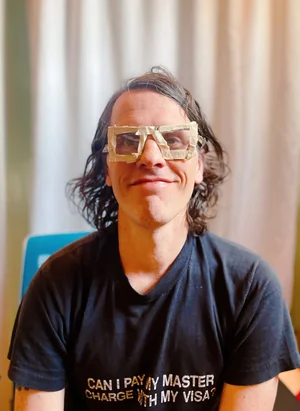
Episode 19: Jacob Vaughan
Jacob Vaughan: When I went to Mexico, I just decided to sell all my stuff and not have any plan for coming back. And I actually had a larger plan that I didn't fulfill. Like I was going to go to Mexico and then try to get to the coast, get on a boat and cross the ocean and keep going around the world.
Josh Caldwell: Hello, my atypical daydreamers. It's Josh, your fearless leader. Actually, I'm full of fear, but I don't let that get in the way. And it didn't get in the way of my guest, Jacob Vaughan. He's a writer and director, and once upon a time, he sold everything, put on a backpack, and headed to Mexico where he found his inner compass.
Jacob Vaughan: I was in my early 20s and I'm half Mexican but I don't look Mexican. I look white. My Caucasian father gave me most of his genetics. And I really love my Mexican heritage. I'm second-generation American and I think from a very early age I didn't like who I was and I wanted to be different. Identifying with my Mexican heritage was a way to sort of pretend to be different. I grew up in a very solid upper middle class suburban upbringing in Northwest Houston. My life was incredibly boring. I had been to college and I'd finished college and I just wanted to have an other type experience.
I was living in Austin at the time and a friend of mine named Alan Watts, who is not the philosopher Alan Watts, told me about this. He went down for like two weeks to Chiapas, which is a southern state in Mexico. All I knew about Chiapas at that time was that there was a lot of fighting going on. There were rebels fighting the government. And I was like, Whoa, you went to Chiapas? And he's like, Yeah. How did you get there? I took a bus. Wait, how did you know where to go? And he was just like, there's buses to everywhere. And it's super cheap. American dollars go very far in Mexico.
Growing up, I always thought Mexico was synonymous with dangerous. You don't go to Mexico. You go backpacking in Europe. So I took notes. I basically said, what did you do? Where did you go? And so I took two weeks and went over Christmas to Chiapas and went exactly where he went.
Jacob Vaughan: I took a bus all the way down there. It was amazing. I found the place where he stayed. I bought a hammock. I slept in a palapa, which is like four poles with a thatched roof. I went and looked at the ruins. What I found out is that you instantly hook up with other travelers. You meet people and you're asking the same questions. Where are you from? How long have you been here? What's your plan? Where are you going next? It's like the same five questions you ask every other fellow traveler. And so you hook up with these people and I had a glimpse of this amazing freedom of being able to go anywhere and do anything in Mexico.
Two weeks wasn't enough. By the time I came back, my mind was blown and Mexico was my new favorite place on the planet. I wanted to go back. I decided at that point to try to work towards paying off all my debt because I had some credit card debt. And then I wanted to get rid of my apartment. I wanted to get rid of all my stuff. I didn't want to have anything weighing me down. And I wanted to go back to Mexico with no return trip planned.
This was in 1999 when I was prepping to go, and it just so happened that I was lining up my trip to be in Mexico during Y2K. Remember Y2K? Everybody thought it was gonna be a disaster and that civilization was gonna shut down. And I thought, this is perfect because I'm going to go to a place that does not rely on computers for the infrastructure to run. So if anything does happen, I'm going to be fine. I'm going to be on a beach in Tulum.
So I got out of my lease and I gave away all my stuff. I had a party and I was like, here, take the bed. Here, take my pots and pans.
Jacob Vaughan: There were a couple of friends who were nervous about me and they were like, this is what people do before they commit suicide or like they have a plan. I was like, no, no, no, I'm fine. So that's what I did. I got my backpack, loaded it up. That was all I owned and I left and got on a bus and crossed the border.
Jacob Vaughan: I was traveling with this guy named Abe and Abe was an avid traveler. He told me he hitchhiked all the time in Canada and I was like, how do you do that? Isn't that dangerous? And he said, no, here's the way you do it. Put out your thumb, car pulls over. The first thing you do is ask them, where are you headed? In the time interval that it takes for them to answer you, you get a read on them. You get a vibe. You look at the situation inside their car. You look at them. You just get the energy. And if you get a good vibe and they're headed to the same place, you say, that's where I'm going, can I get a ride? But if they say where they're going and you don't get a good vibe, you can pass.
I wanted to hitchhike in Mexico, of all places, which is really dumb. I was 22, 23. This was dumb. So I did it. I took my backpack and I was at the edge of town, a big city, six million people, called Culiacan. And it was like I was on a highway. It was ridiculous. I don't know what I was thinking, but I stood out there with my thumb out and this guy in a truck pulled over. It was a small truck, one of those little Subaru trucks, and it had a business placard on the side. He had some furniture in the back.
I went up to the window and I said, where are you headed? He said, Uruapan, Michoacan, which is where I wanted to go. In that interval of time, it seemed to me like he was a good guy. It was a business car so he was doing something official for his company. And he had all this stuff in the back. I just got a good feeling from him. So I said, okay. We got my backpack and put it in the back, which I thought, man, that was a mistake. Because if I need to make a quick exit, I can't grab my backpack and jump out of the car. I really put all my eggs into this basket. Got in the car. We started driving.
Jacob Vaughan: And he said, when I saw you standing out there, it reminded me of my days traveling around, because I took some time off after college and I traveled around Mexico. And I was like, this is my guy. This is great. And then it was even more confirmed because I had been reading all of Carlos Castaneda's books. Castaneda being an anthropologist from California who went to Mexico and found, and wanted to do research on peyote and other power plants. He met Don Juan who is a Yaqui warrior shaman. He had all these experiences with Don Juan and wrote about them in like 10 books. They had to do with lucid dreaming and psychedelic experiences. Don Juan was always talking about how this is serious stuff, training to become a warrior, to go through life as a warrior does. Impeccable is what he always talked about. Lowering self-importance, dropping self-importance.
I don't know how we got onto the conversation, me and this driver, but it turned out that he had read all the Castaneda books. He was a big fan. So we started talking about that. These are experiences that are sort of beyond your understanding. Like how does this happen? Everyone has these experiences. We all know when they happen, these moments of synchronicity. I was in a mode of travel in which this was my state of mind all the time. It just truly felt like a river, like it was just a river flowing.
Josh Caldwell: Hey, Josh here. I love making this podcast and I'd love to make it my full-time gig. Besides telling the stories, I'm basically a one-man band and that takes time. If you're enjoying the podcast, please consider becoming a patron. You'll have access to loads of great bonus stories and you'll have the satisfaction of knowing that you're supporting a truly independent podcast. Find the Patreon link in the show notes. And thanks.
Jacob Vaughan: So I should back up and explain why I was going to Michoacan. In Chihuahua, I was walking around the city and I was in one of the town squares. There were buskers, people playing instruments for money, beggars, young kids making out. That's the place to do everything in the town square. And there was this one guy, tall, bald, like shaved head, strapping guy. He had these poster boards laid out on the ground and he was taking donations. All his material was about the reforestation of Mexico. I started talking to him and I could tell he wasn't crazy. He was a real deep guy, very educated, very invested in this mission of his. I hung out with him for a few hours and we got dinner.
He was not threatening at all. Very friendly. We were talking. And he asked me where I was headed. And I said, I don't know. And he goes, you should go to Michoacan, where I'm from. And he said, there's this beautiful small little town where I live, where my family's from. And it's beautiful and the women there are beautiful. If you don't have any other place to go, you should go. I've got family there, they would put you up, it would be great.
I thought maybe I might do that. I put it in the back of my head. And he gave me a photograph of himself. On the back of it he scribbled out a letter of introduction to his brother who lived there. He just wrote this note on the back that I couldn't totally read. His handwriting wasn't that great, but I got the gist. Which is like, this is Jacobo. That's how I was traveling, under the name Jacobo, which is my name in Spanish. He's traveling and please treat him like family.
So I put that picture in my little Lonely Planet Mexico guidebook and I kept it there. The name of his town was Tinguindin. I looked on a map and I found Tinguindin. It's in Michoacan, in the mountains.
So here I am. I'm hitchhiking and I have a vague idea that I want to head down to Michoacan. And the car that pulled over, this guy, he was going to a town called Uruapan, which is a city in Michoacan, close enough to where I wanted to go. I find a bus and I realized I'm going to get there at night. It's not ideal to go to a town that's actually a village, a very small village, obviously things shut down at night. It was like eight or nine o'clock at night and I was really going into the void.
The bus pulls up and there's like a little shack there with some chips and cokes and drinks. I get off the bus. This is it. I'm getting off the bus. I'm committing. The bus drives away. I go up to the little food stand and I talked to the guy and I said, listen, this guy Carlos sent me, this is his picture, do you know him? And he looked at the picture and he was like, yeah, yeah, yeah, yeah. He says, El Diablo. And this kid comes over, this 18 year old kid whose nickname is El Diablo. I would come to find out that everyone in Mexico has a nickname.
Jacob Vaughan: El Diablo, come over here. I'm thinking, shit, the devil is gonna take me somewhere. And the guy at the food stand says, take this guy over to, you know, and he starts walking me down into the village. And he points to a door. So I knock on it and this guy opens the door. Okay, this is a tall strapping good looking guy with a cowboy hat and a goatee. Looks just like the guy I met in Chihuahua. Like they look like brothers and they are.
I say, hey, you don't know me and I'm really sorry to be knocking on your door. I met this guy and he said, come here. And here I am. And here's his picture. He takes the picture. He looks very suspicious at me. What's this skinny little white dude doing here? And he takes the picture, he reads the back, and then he suddenly changes. You know that moment in Romancing the Stone when he says, John Wilder? The John Wilder? That was the shift in this guy. He opens the door and he's like, Jacobo, come on in, man. My brother, my silly brother. And he's like, I haven't seen that guy in so long. Oh my God. And he starts speaking English to me. He says, yeah, come in. You'll stay here. He goes, you'll stay in my kid's room. This is my wife over there. He's introducing me to everybody.
I drop my bags off and he says, let's go upstairs. So we go up to the roof and he says, this town is all about avocados. In every direction is avocado fields. He says, I'll take you to my ranch tomorrow. But right now you stay here tonight. And I literally threw a dart at a map and landed into a nice mattress. Really nice place to stay. And that is where I landed. And I ended up staying there for like a month.
Jacob Vaughan: So this guy takes me to his dad's ranch house. He says, you can stay here as long as you'd like. And he says, give me that photo. He takes the photo and he turns it back and he reads the thing again. And he says, right here, you're gonna teach English. You're gonna teach English to the kids in our little village. This is so great. And I was like, I'm sorry, what? The guy I had met in Chihuahua had said in his note that this guy is gonna come down and he's gonna teach the kids English. And I had no idea.
Jacob Vaughan: I think I was there for like four weeks and I did it. I sent for textbooks, English textbooks, and I created a sign up sheet. It did not go well. Like 100 people show up the first day, 10 people show up the next day. I'm not a born English teacher. I tried. I tried to fulfill my destiny.
There's something about fully committing yourself to an endeavor. I gave away all my stuff. I bought a one-way ticket. I got on the bus and I went. You're open. It somehow opens you up to things and you can sort of read the tea leaves a little bit better. I've got the sense as I travel around of freedom and like anything is possible. We would always say, me and whoever I was traveling with, todo es posible en Mexico. Todo es posible.
Josh Caldwell: I want to thank Jake for sharing his experience. Make sure to check out his photography Instagram at senior.foto. That's F-O-T-O. And keep an eye out for his forthcoming film, Home Safe. This podcast was created and produced by me, Josh Caldwell. Music by Visual Aid, my side music project. General support and copywriting by Miranda Caldwell. If you like the show, please follow, subscribe, rate, and review wherever you listen to podcasts. And if you'd like to financially support the show, check out my Patreon page. You'll have access to loads of great bonus stories. You can find the link in the show notes. Thank you for listening, and I hope you come back next week.