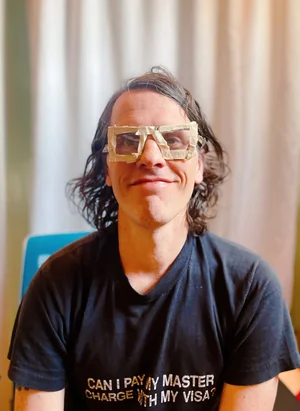
Episode 55: Wayne Gottstine
Wayne Gottstine: And so I bought me just this little guitar just to sit on the porch that summer. Because that's all I could do was just sit on the porch that summer and started playing guitar and I just was like, this is my life. Music is my life. I cannot, this is gonna keep me alive.
Josh Caldwell: Hello, my atypical daydreamers. Welcome to the show. It's a podcast about life on the road. Now, I'm no scientist, but as I understand it, the reason we see in 3D is because each eye takes in a slightly different view, two perspectives. And when our brain stitches those images together, it creates depth and distance and a sense of where things actually are. And I think this is a useful metaphor for some of the deepest wisdom I've gained in my life. I grew up knowing what it meant to be someone's son, but when I became a father, that relationship took on a whole new depth with both sides in my sight. Now my guest today is Wayne Gottstine. He's a musician and a songwriter out of Lawrence, Kansas. And today Wayne shows us two sides of what it means to face a terminal diagnosis. And what it looks like to meet life on life's terms by doing the thing you love with the time you're given. And how in the end, you're left with a deep sense of purpose and gratitude.
Wayne Gottstine: I've been in a band called Split Lip Rayfield for thirty, almost thirty-one years now. At first we were a four-piece. It was me, Kirk Rundstrom, Eric Martis, Jeff Eaton, and we were just on fire. We were really climbing the ladder at this point. And this was in the early 2000s. And then Kirk, our guitar player, he got esophageal cancer. They tried to do a surgery on it. The surgery was unsuccessful. And they said, you maybe have six months to live. And so what he wanted to do was go on tour.
And we toured for six months, just as he was falling apart, as he was getting skinnier and skinnier. I bet he weighed 140 pounds when he finally passed away. We did a show four days before he passed away. And we just hopped in a van. We did a West Coast tour, we went to East Coast, we went all around everywhere. His tenacity, his love of music, his love of entertainment was just palpable. And of course we were there to support him, to do what he wanted to do for the rest of his short life. And it was so incredibly intense. We were brothers. The band is still together. The three of us still play in missing man formation. That's what we called it for years. And we played his songs. We still play his songs. We played a New Year's Eve show, a whole set of his songs.
But his strength and his courage throughout that last tour was just incredible. He couldn't eat, couldn't swallow. He was on IVs all the time. And we drove around probably fifteen thousand miles playing shows. And then we didn't do shows for about a year. And then our good friend, the Reverend Horton Heat, he said, hey, I'm coming to town. Why don't you guys open up for me as a three-piece? And we're like, well, we don't know. We're not sure. So we got together and practiced and we're like, you know, we kind of still sound like us. We're just missing a man. And so we did it. And then he said, come on tour with us. So then we ended up doing like a hundred shows with the Reverend.
Wayne Gottstine: Those times got pretty crazy. We were doing shows with the Reverend, with Cracker, all over the East Coast. And I had this party jacket. That's what I called it. It was just a suit jacket. And I decided I was going to start blending in with the world and looking less like a rocker and more like a doctor. So I would wear this blazer all the time. And we were in Rochester, New York, and there was this fight. And the bartender was in the wrong. He was totally in the wrong and the guy was drunk, yes, but he did not deserve to be slammed down to the ground. And so there's all this hubbub. I'm in my party jacket. And because I look like this respectable party guy, I go up to the police and I'm like, I'm pretty sure this guy has a head injury. I've got a bit of a medical background.
Wayne Gottstine: I always wondered, because Kirk had small children. He had an eight-year-old and a ten-year-old. And his wife, we dragged them all around the country. They were with us a lot. They didn't even go to school hardly half a year. It just didn't matter at that point. When your father's dying, school, whatever, you can catch up. They've grown up, they're both doing great now. This was 2007 when he passed away. So it's been almost nineteen years ago.
I couldn't quite understand. I was behind him and I was gonna do that. I was like, whatever you wanna do, I'm gonna go do and play these shows. I couldn't quite understand why he would wanna do that. But then five years ago I was diagnosed with stage four lung cancer.
Wayne Gottstine: I played so many shows since then. First I did a bunch of chemo and all this business, and we thought we had it under control. Then it came back, and then I ended up losing my lung. Two-thirds of my right lung is gone now. But I can still sing. I played fifty shows last year. I just played a show Monday or Tuesday night, it doesn't matter. Being faced with almost certain death, the survival rate at five years of small cell lung cancer is ten percent. And I'm at five years now. And I'm at no evidence of disease. Everything is looking good. I get CT scans every three months.
First I couldn't play guitar for like six months because the chemo was very intense. I was having these surgeries. My hands were just shaking from the chemo and the radiation and I couldn't play guitar. And it killed my gallbladder, so I had to have my gallbladder removed. And so I bought me just this little guitar just to sit on the porch that summer. Because that's all I could do was just sit on the porch that summer and started playing guitar. And I just was like, this is my life. Music is my life. I cannot, this is gonna keep me alive. And I just started playing more and singing and getting my voice back and getting my hands back and getting my ideas back.
Wayne Gottstine: And now, when you are given an expiration date, you want to do the thing you love as much as you can. And I love making music. I practice every single day. I play as many shows as I can. I have four bands and it is everything to me. I'm not super successful or rich or anything like that. I'm squeaking by, making it, I can get the bills paid. And that's enough for me. Because playing music is everything to me.
And I've been working with this group out of Kansas City. Every Monday night at this church, they feed four hundred people. Reverend Mindy. She is like the epitome of what you think a Christian should be like. Her life is about helping people. Before the show, she says, some of these people are gonna come in here and go to sleep. They're just getting out of the cold. But the people that come in and watch the show, they get in line for dinner first. So first you have this show and then they feed you this dinner. And so I had about fifty people into the chapel. The chapel was beautiful. And I just played acoustically. It just sounded so good. And they were such good listeners. And once they got warmed up to my style, because I do requests, I brought my laptop so I could pull up songs. After they got warmed up to me a little bit, a couple of them were like, you know any George Strait? I was like, you bet. How about some Sam Cooke? Yes, you got it.
Wayne Gottstine: And it was so touching. When I put my guitar away, she told me, at 5:15 they're all gonna scoot out of here and go get in line. They did not. It was 5:25 and most of them were still in the room. So I went to go thank everybody for watching. Because these people have it hard. They're living on the streets. They're just people. And when you get to talk to them in a situation like that, you can see that these are just normal people having a hard time.
And this big old guy, I mean he was huge, like six-seven, and he came up and he was like, man, I don't get to see live music ever. He's like, this is a treat. This was a special moment for me. When I went out to my car to drive home, I admit it, I just wept. Just to see the simple act of playing music for people who don't get that. Not everybody gets that. They don't have Spotify. They don't get to go to clubs. They're trying to find a warm place to sleep at night.
I feel different after that experience. I'm just so grateful for the things that I do have and for the time that I do have in this life and then the luck that I've had with this cancer. Because a lot of times cancer is location, location, and luck. You know, science has gone a long way, but it's still a pretty rough game. To be able to share music with people who don't just have access like we have it. And talking with Reverend Mindy, she is such an impressive person. Her whole life is helping people. She feeds them every Monday because that's the only she can afford to do it once a week. She has outreach programs. If you have a health situation, they're gonna help you try to get it figured out. She was a true humanitarian and I was in awe to be in her presence.
So that was my last gig Monday night. Like I tell my younger musician friends, just go play a gig. Just don't worry about perfection. Just go out. What people want is they want to connect with something real. People are looking for something real.
Josh Caldwell: I want to thank Wayne for sharing his experience. Be sure to find him on Instagram and TikTok and check out his legendary band Split Lip Rayfield at stitchgiver.com. All the links in the show notes. And for anyone facing a terminal illness or supporting someone who is, Wayne's story may offer a moment of hope and light. It certainly did for me. This podcast is created and produced by me, Josh Caldwell. Music by Visual Aid, my side music project. General support and copywriting by Miranda Caldwell. Thank you for listening, and I hope you come back next time.