Episode 45: Benjamin Hill
Benjamin Hill: And I could just feel, not hostile but protective, this like envelope, like just closing in, this ring of people closing in around me, kind of like, who is this guy?
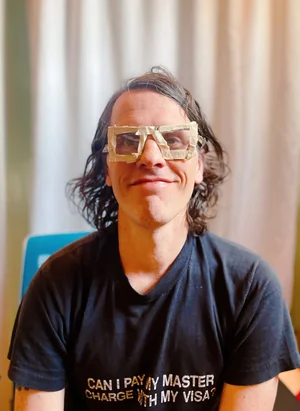
Josh Caldwell: Hello, my atypical daydreamers. Welcome to the podcast. My guest today is Benjamin Hill. He's a writer who covers the business and culture of minor league baseball. Of all the American sports, baseball has some of the richest lore and culture. Ben's ongoing journey across the US has become a patchwork portrait of America, all seen through the lens of minor league baseball.
Benjamin Hill: I have been traveling across America visiting minor league ballparks, covering the business and culture of minor league baseball for twenty years now, fifteen years of doing the road trips. I've been to 189 ballparks, well over 300 ballpark visits. I'd like to say I've spent over a year of my life on the road. And it's a job that had never existed before, a job I didn't really have an idea I could do until it evolved over years, going from writing game recaps to learning about the minor league baseball industry through stories I was assigned to write and being more attracted to the promotions that teams were doing and how they were operating.
I got asked to write a weekly promo column that one of the editors at the site was doing and didn't really care about. That was just perfect for me because I could make jokes about goofy minor league promotions. That's really what opened the door to what I do now. I realized that people in the industry were reading my column because no one had ever covered the minor league baseball industry in real time. And because teams don't compete with one another, they're always interested in sharing ideas. Every minor league baseball team was a unique reflection of its own community. And therefore the 160 teams together were a reflection of America writ large. This wasn't some grand thesis statement. It just developed over years.
2009, I was thirty years old, divorced, still part-time when the year started. I'm living with a roommate, a college friend of mine. I retained custody of two cats in my divorce, and then my new roommate has two more. I'm just a thirty-year-old single dude living with another guy and four cats, getting paid part-time to write about minor league baseball and barely hanging on. And at some point during the 2009 season, I was offered a full-time job. I wasn't expecting it. In a weird way, I didn't feel super happy as much as just, huh. Now that it worked out, it made me feel almost skeptical. But of course I wanted to accept it.
Benjamin Hill: Then that led to the question of, all right, I have a full-time job writing about minor league baseball. At that time I'd only been to maybe five or six minor league ballparks. So my whole thing going into my first full-time season in 2010 was that I want to visit minor league ballparks. I wanted to make my ballpark visits around a good event or occasion, something with a little oomph behind it.
During that 2009-2010 offseason, I learned about a team called the Mobile Bay Bears in Mobile, Alabama. They played at Hank Aaron Stadium, named after native son Hank Aaron. And they announced an initiative to move Hank Aaron's childhood home, a very modest small one-story white frame wooden house, to the grounds of the ballpark, refurbish it, and open it as the Hank Aaron Childhood Home and Museum. So I got approval to go cover that. Not only were they opening Hank Aaron's childhood home as a museum on the grounds of the stadium, Hank Aaron would be there. And not only that, they had this massive guest list of Hall of Famers: Willie Mays, Bob Feller, Rickey Henderson, Bruce Sutter, Reggie Jackson, Ozzie Smith, as well as then MLB Commissioner Bud Selig.
Benjamin Hill: I put myself in a situation where not only am I trying to develop a template for covering minor league baseball on location, but now I'm at this premier event with all these Hall of Famers. This was fifteen years ago and it feels like it might as well have been fifty or a hundred. It was just a thing a minor league team did. There wasn't much awareness within Major League Baseball that this was happening. And I'd never done this before. I don't even have a smartphone yet. I don't have a GPS. I have printed-out MapQuest directions, a flip phone, and a flip camera, which was this little rectangular camera that no matter how steady you tried to hold it, the footage would just shake up and down.
So I get there. The night before I tried to contact the Mobile Bay Bears media relations director, Wayne Randazzo, who now does play-by-play for the New York Mets. I just show up the next day and it's a mob scene of all local media. And me is the one national writer.
Benjamin Hill: All these Hall of Famers are just milling about. I interview Bob Feller, who pitched for Cleveland about seventy years ago. He has since passed away. I'm just interviewing on my flip cam. Rickey Henderson, who I loved as a kid, I was on the same flight as him leaving two days later. I talked to him. Reggie Jackson pulled off the most Reggie Jackson type maneuver. Everyone else I talked to was very friendly. He put his hand over my flip cam and slowly pushed my hand down, like, I'm not talking to you, kid. And in a way I was like, are you kidding me, Reggie Jackson? I'm not some hardened member of the New York tabloid media coming after you after you went 0 for 4. I'm just some young writer trying to talk to you about Hank Aaron. So I was just grabbing all these interviews with Hall of Famers all over the place, not knowing really what I'd do with it.
As well as videotaping the ceremony itself, where Hank Aaron's standing on the porch of his childhood home saying it was like the greatest day of his life. I'm not gonna tell you, Hank Aaron, what the greatest day of your life is, but I remember thinking, I don't know, maybe setting the all-time Major League home run record might be a little better than this.
Benjamin Hill: He was really overcome. Just literally walking through his childhood home, which the team had filled with memorabilia related to his career as well as period furnishings similar to what he would have grown up with. Fortunately the team was pretty helpful to me in knowing who I was and helping facilitate me getting into areas where other people weren't allowed.
My job usually was a niche within a niche. I'm a major league baseball employee, but I'm covering minor league baseball. And I'm not even covering the prospects or the games, I'm covering how the industry operates. So I was usually very distant from the rest of the company editorially. But at some point, through my boss to her boss, it did get further up the ranks that hey, we have this guy at this event. And so the one upper-level directive I got was that Hank Aaron was being very protective. He gave his speech but didn't have much media availability. And I was told just don't go up and start talking to Hank Aaron.
But I got a directive from who knows how many levels above me in the company that there was some controversial comment that a player named Orlando Hudson had made, and if Ben is near Hank Aaron, we need to get Hank Aaron's reaction to what Orlando Hudson said. And I'm just like, no. I'm just trying to not mess up here. No one is allowed to talk to Hank Aaron. But I felt like if this is coming from upper-level people, I need to say I tried. So I walk into this private room where Hank Aaron is with friends and family. And I go up to him and I'm like, excuse me, Mr. Aaron, so Orlando Hudson said this. And I could just feel, not hostile but protective, this envelope like just closing in, this ring of people closing in around me. Like, who is this guy? Trying to talk about something that has nothing to do with the opening of the museum. And I could feel that energy and Hank's kind of looking at me like, who is this guy? And I was just like, sorry, sorry, sorry. And I ran out of the room.
Benjamin Hill: Never again. That was not the right time to do that. This was not the place. But I just remember feeling throughout the night so stressed about everything. I need to talk to these Hall of Famers, I need to get all these quotes. And then being up in my hotel room until three or four in the morning in Mobile. I'd never been in the city of Mobile. The air felt hot and thick, and there was that almost supernatural feeling to it that reminded me a little of New Orleans, but it felt a little more menacing. I was just trying to get my bearings.
I spent all night writing an article about my night at the Hank Aaron Museum, throwing in quotes from the Hall of Famers. Now I look back and I'm like, where are those interviews? I've been working fifteen years, traveling all over the place, and I've never been around so many Hall of Famers at one time. And the fact that it was my very first visit just made it all the more memorable. It must have worked, because the next month I was on the road again. I went to the Rickwood Classic in Birmingham, a ballpark that opened in 1910. I went to the hundredth anniversary of the Rickwood Classic that year. I went to the last game at Rosenblatt Stadium in Omaha.
I pulled it off. And the fact that I'm here fifteen years later, still doing it, I think a lot of it can be traced back to making my way through that night in Mobile, Alabama, in 2010. One thing I haven't really done, and I wish I had, is write just about my day or the little things that don't make it into stories. Doing this right now, I just wish I had some voice memo or journal entry from April 2010 where I really went through the nuts and bolts of navigating that night and the particular stresses. Fifteen years later I'm like, you gotta start doing that. You gotta start telling the story behind the story. But then when I'm on the road I'm just like, that's one more thing. You think I wanna sit down and write some more? I wanna go to Buffalo Wild Wings at 11:30 at night and get some wings and watch some really bad TV and call it a night. That's about it.
Josh Caldwell: I want to thank Ben for sharing his experience. Be sure to check out his newsletter, Baseball Traveler, his podcast, Show Before the Show, and find him on X and Instagram. All links in the show notes. Do you know anyone who loves baseball? Text them this episode. This podcast is created and produced by me, Josh Caldwell. Music by Visual Aid, my side music project. General support and copywriting by Miranda Caldwell. Thank you for listening, and I hope you come back next time.