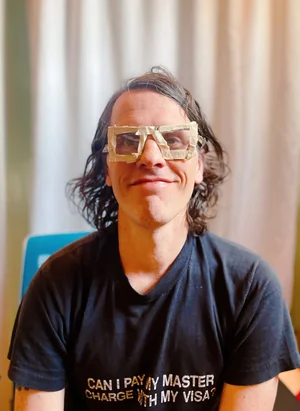
Episode 44: Michael Shaikh
Michael Shaikh: He was an incredible cook, like really just an incredible cook. And I'm thinking that what I'm seeing in front of me is an amalgamation and fusion of the various episodes of his life and culinary life coming together on this table. And he said, no, Michael, this is Afghan. And the reason why you haven't seen it before is because it's disappearing.
Josh Caldwell: Hello, my atypical daydreamers. Welcome to the podcast, a show about life on the road. My guest today is Michael Shaikh. He's a human rights activist and home cook. He brought these two passions together in the form of a new book called The Last Sweet Bite. Cooking carries lineage. Where did it come from? Who created it? How has it evolved? What people and places shaped it? What are their stories? But recipes and the stories they hold can be lost to time, to war, displacement. Michael has set out to preserve and collect these disappearing recipes and share the lives behind them. And in doing so, he reconnects to who he is and the family he comes from.
Michael Shaikh: I have two incredible parents who really instilled in me and my brother and sister the values of travel and seeing the beauty and the largesse of the world, and also showing compassion to our fellow human beings. My mother's a nurse, my father's a physician. My father came from Pakistan. He lived through the partition of India-Pakistan. My mother was born in Cleveland, Ohio. She's of Irish and Transylvanian descent, both Transylvania that straddles Romanian and present-day Hungary. We used to travel quite a bit and that's how I got to see the world.
I'm the only person in my family who's not in the public health or medical field. Kind of the black sheep of the family. My father always wanted me to be a doctor, but I went into the human rights field. My mother really didn't care. She's like, just do something that'll make you happy and get off the fucking payroll. My job for about fifteen years was investigating war crimes and human rights abuses in conflict zones, mostly in Asia, a little bit in the Middle East and once or twice on the African continent.
One of the conflicts that I spent considerable time working on was the Sri Lankan Civil War, particularly the last phase of it in 2008 and 2009, which was incredibly brutal. In about 2010, I was in India in Tamil Nadu, and I had met this woman named Rajiva. She had escaped that brutal final phase of the war. The civil war in Sri Lanka was between the Sinhalese-dominated south and the Tamil minority that lived in the north and east of the island. The last phase of the war, the Sri Lankan military had pinned the rebels and probably a hundred thousand civilians on a beach on the eastern side of the island no bigger than Central Park. And they shelled and bombed these Tamil people from the air, land, and sea for days. After the Tamil Tigers were beaten, the Sri Lankan military took the civilian survivors and forced them into internment camps.
Michael Shaikh: This woman I met in Tamil Nadu had escaped before she was interned, by the compassion of a Sri Lankan Navy officer. She fled over the Polk Strait and sought a life as a refugee in Tamil Nadu. I had met her about a year after she had fled.
We were outside the home of a very powerful Tamil Nadu politician. She was there trying to ask the same politician for help for many of the Tamil refugees. We were forced to wait outside for hours and hours, and somehow we struck up a conversation that wound its way toward food. I noticed that she held a prominence in the group because she had survived this really tragic genocidal thing on this beach called Mullivaikal. As we were talking, she started asking me, had I ever eaten Eelam Tamil food? I said I'd had it a few times. Then she's asking, have you ever eaten nandu curry? I said no. And she kind of sternly looked at me like only a mother could. She admonished me in Tamil and ripped a notebook out of my hand, took my pen, and handed it to my translator and started dictating him to write down the recipe for her nandu curry. And she told me, I want you to have this because I have no one left to cook for. Otherwise it'll disappear.
Michael Shaikh: I'll never forget it. It was one of the most profound moments I had investigating and studying and learning about human rights abuse and how it affects people's lives and colors their future. So fast forward. I'm in Cleveland, Ohio, back visiting my dad. I often cook Pakistani food for him. One day I decided I was going to make Rajiva's crab curry. I spent a couple of hours making it and took it into the living room. My dad was sitting there and I handed it to him. He gave me a side eye. He's like, what is this? Pakistanis don't really cook with coconut milk or curry leaves like Eelam Tamils do. And he's like, what is this? And he started to eat it. And he's like, this is really good. Where did you learn how to make it?
I told him about Rajiva and I told him about her life and what had happened to her on that beach and the history of the Sri Lankan civil war. And I was able to talk to him and tell him about my career. He had long wanted me to be a doctor, and it's really hard to convey what a human rights investigator actually does on a day to day basis. In that moment I was able to both tell the story of this incredible woman and her survival and this really brutal period, and also a bit about me that my dad hadn't heard before. We were able to connect on a level that I hadn't really connected with him prior about my professional career and what I do when I'm traveling abroad. And in that moment I really just saw the power of food to tell a story.
Josh Caldwell: Hey, it's Josh. Hope you're enjoying the podcast. And if so, are you wanting more road stories? Well, good news. I've got you covered. Consider becoming a patron. You'll have access to loads of great bonus stories that there just wasn't time for. And you'll be supporting a truly independent podcast. Find the link in the show notes and thanks. Now back to the show.
Michael Shaikh: I used to think my dad had magic powers because he could speak several different languages. When I would go to Pakistan as a little child with my parents, I would constantly get made fun of by my cousins because I was the American kid, and I felt this sense of injustice. I wanted to learn that language so I could fight back. I wanted an even playing field. I was like seven or eight years old, and I remember asking my dad if he would teach me Sindhi. That was the language of his ethnic group. And he's like, you don't really need it in Ohio. You're an American kid. Your mother doesn't speak it. I'm too busy as a doctor to teach it to you. It's not that important right now. Fair enough. Everything he said was absolutely legitimate.
The language bug never really left me. I studied Spanish in high school. It never really took. I was a shitty student. But when I went to college in the late nineties, everyone was still stuck on teaching European languages. As a political science and Asian studies major, I had to study another language, and I didn't want to study a European language. I really wanted to study Urdu or Hindi, but I picked Japanese because it was one of the only Asian languages they taught. And technically Pakistan and Japan are both Asian countries, so that was my logic.
Michael Shaikh: It was fortuitous in that I had this really wonderful teacher, James Henry Holland. He gave me the key to understand why I hadn't been grasping Spanish in high school. My high school Spanish teachers taught Spanish like a mathematical equation. Professor Holland taught me to see Japanese as a way of being in the world, a culture, a way that the Japanese communicate not only with themselves but with the world around them. It was a different way of approaching a language.
Japanese is very difficult. I still struggle with it even though I've studied for over a decade. And I really fell in love with the language. After college, I lived in a small fishing village in Miyazaki, Japan. There was this little izakaya that I used to go to every night. The owner was a single mom. She kind of took me under her wing. I became like her foreign son. Because I went there so much, I would spend as much time in the front of the bar drinking as in the back doing dishes on busy nights. The owner's name was Keiko. She was always worried because I was in Japan by myself, not married, living alone. It only meant I wasn't eating well. And so she taught me how to cook. That's really where I learned how to cook, in her restaurant. One night during our impromptu cooking classes, she was teaching me how to make karaage, this beautiful Japanese fried chicken. Here I am learning her family recipes in her language, and I couldn't do that in my father's or mother's language.
So I went home and started talking to my dad about his life in Pakistan. Language came up again. I prodded him a little. Why didn't you teach us Sindhi? He offered the same explanation, but then he said something new. It was the first time he really opened up to me about what he experienced during the partition of India-Pakistan in the late 1940s. Partition was when the British cleaved Pakistan and India into two separate countries. It was really, really violent. Still one of the largest migrations of humans in modern history. Millions were killed. My dad was a teenager on the present-day Pakistan side. My uncles were in India when partition happened and witnessed horrendous things trying to cross a new international border. My father started telling me what he had seen. And it became very clear that a lot of what he had seen had fused onto the parts of his culture that he really loved. He said in not so many words that it was too painful for him to teach us Sindhi because what he had seen reminded him too much of that painful time.
Michael Shaikh: And fast forward. I'm in Afghanistan. I'm working for Human Rights Watch, doing a lot of work on civilian casualties caused by both the Taliban and international forces. It was my last night in the country. A dear friend of mine who's an Afghan, and who like many Afghans had been a refugee many times in the thirty-year war, had just made this incredible dinner. I saw these dishes and I'd never seen them in all the years I had been traveling in the country, interviewing people, and eating in different parts of the country. I kind of arrogantly thought I'd seen what was Afghan cuisine. But in that moment I arrogantly asked him, is this Afghan? He was an incredible cook. And I'm thinking what I'm seeing in front of me is an amalgamation and fusion of the various episodes of his life and culinary life coming together on this table. And he said, no, Michael, this is Afghan. And the reason why you haven't seen it before is because it's disappearing.
We started talking. I could see in that moment that the same tentacles that had reached down through generations and stolen language from my family was stealing Afghanistan's food one recipe at a time. Everywhere I went after that in my human rights career, I started asking people how the war was changing the food, how the violence around them was changing the food. And people just opened up. I was fascinated by this realization from my friend, and just asking this question opened up a whole new way of seeing the world. Not only was the violence I was investigating changing the lives of the people I was talking to, but it was changing the music, the art, the architecture, even the food. And people started giving me recipes they were worried about disappearing. Take this, you know. And I have a few notebooks with recipes written down from them.
Food is an umbilical cord to our identities. And that was something I heard everywhere I went. When I started asking how violence was changing the cuisine, it was among the most important things to them. Almost more important than language in some ways. And I felt an immediate connection to these sentiments because today I still struggle to speak Sindhi, but the way I connect to that culture is cooking that food and learning how to cook that food. I learned about my family's history, my father's history, the history of the subcontinent through food. And that's primarily how I learn today.
Josh Caldwell: I want to thank Michael for sharing his experience. Be sure to check out his new book, The Last Sweet Bite: Stories and Recipes of Culinary Heritage, Lost and Found. Also you can find him at michaelshaikh.com and on Instagram at Milkshake, that's S-H-A-I-K-H. Links in the show notes. This podcast is created and produced by me, Josh Caldwell. Music by Visual Aid, my side music project. General support and copywriting by Miranda Caldwell. Thank you for listening, and I hope you come back next time.