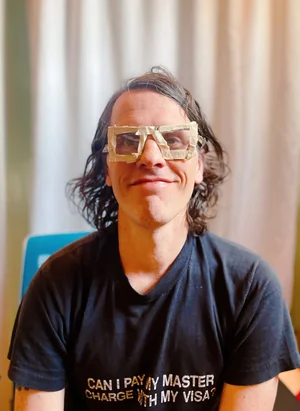
Episode 36: Chris Robinson
Chris Robinson: My friends got out with me and we were all standing around and I was in kind of the center of this fiasco and I look up and I'm surrounded by eight or nine locals just watching me throw up.
Josh Caldwell: Atypical daydreamers, welcome to the show. My guest today is Chris Robinson. He's a lifelong skater and an old friend of mine. Once upon a time, young Chris set off from San Francisco to Florida to become a certified sailor, and somewhere along the way, had one too many bottles of rum.
Chris Robinson: So this is a rhetorical question then. Because we grew up in the same decade really, right? Eighties maybe. I'm from seventy six, that's when I was born. I have this weird feeling that the word plethora, the only time I ever heard that word was in the movie Three Amigos. And then after that I started to use it all the time. And now the only time I ever hear the word plethora is people in our generation who use it. And I never hear it any other way. So I feel like Martin Short and Steve Martin and Chevy Chase and the guy who actually uses that word enriched my vocabulary. I went and looked it up, man, and for weeks after that movie came out, we would say it all the time. I don't hear it anymore. My kids don't know what that word means.
Chris Robinson: I'd moved out to San Francisco when I was 19 from Austin with this desire to go pro and become, you know, just like actors move to Hollywood to try to become a film star, a lot of skaters back then would go out to the West Coast, to California. Maybe New York sometimes would be okay, but a lot of people migrated to places like San Francisco and LA to try to see if they had the right stuff and go pro. So I moved out there with a friend when I was 19. And the first thing you do is go find some job to help pay the rent and then spend most of your time with this activity, hoping to make a breakthrough or whatever.
So I was living in San Francisco for a while and I'd had two roommates by then. First roommate was Zach Hudson. We moved out there together, and then six or seven months later I moved in with Brian Claybrook. And I don't know if it's unusual for a skater, but I didn't know anyone else at that time who was also wanting to go the academic route and look into college. There were people that said yeah, maybe I'll go to college one day or something. But I also felt pressure from people I knew and people in my family like, yeah, that's also something you should probably do. So I was going to City College, San Francisco. I had this balance of odd jobs like working in a Kodak photo development place or Kinkos or something like that. And then I would skate a whole lot. And then at the same time I was like, yeah, I have to balance it out with something academic too.
I had been in community college in Austin, ACC, before that. So I was this kind of slow snail pace adding the classes you needed to get a bachelor's. But even that wasn't enough. I wanted to add like a fourth element to it. And it had to be more gritty or more real life or more hands-on or something. And then this opportunity came up through my stepdad's relatives, that I could go for four or five months to Florida and learn everything about boating, like become a certified captain.
Chris Robinson: And I got bit by it. I was like, yeah, okay, I can do this brief break from my academic studies and skating. I already knew then that I really have to give skating all I've got. Just like an actor, man, you probably have to be there just forever and hope for that break. And I guess I was smart enough to realize that. And the deal was that I moved out to this little tiny town in Florida, not far from Tampa I want to say. And people like Navy SEALs and stuff would be trained there too. So it was a legit school that would help people in seamanship.
I was a weird kind of addition to this. I'm getting in there with these guys, there's like a class of 18 people, they're all about my age, and they're trying as hard as they can to become first mate or maybe even captain on a private boat down there. And I'm sitting there like, I was super into Beethoven at that time. I'd fall asleep. We had a roommate situation, you lived in a room with another dude, and this guy was awesome, like the typical frat boy but super nice too. And I just remember one of my favorite memories was that I would put on Walter Gieseking's Beethoven recordings, the sonatas, and I would listen to him every night before I went to sleep. And by the end of that period, the guy was like, man, this shit's awesome, this is dope, man. Let's throw that on again. All the Moonlight Sonata, all that stuff.
Josh Caldwell: Hey, it's Josh. Hope you're enjoying the podcast. And if so, are you wanting more road stories? Well, good news. I've got you covered. Consider becoming a patron. You'll have access to loads of great bonus stories that there just wasn't time for. And you'll be supporting a truly independent podcast. Find the link in the show notes and thanks. Now back to the show.
Chris Robinson: I went to this school for about four months and it was hard. A lot of theory and a lot of practical exams where you would take boats out in the ICW there in Florida on the intercoastal waterways, and you would have to learn how to navigate in all kinds of weather scenarios. We learned how to use a sextant to navigate by the stars. Do all this technical stuff that I've also since forgotten. But in the afternoons in Florida, almost like clockwork, every afternoon a rainstorm would come for 45 minutes. It'd be really hot and then this rainstorm would blow in, cool everything down, and then go away again. And then we would be like, wow, okay, the rain's over. Let's go. What are we gonna do? And a lot of those guys would be like, let's go get a bag of oysters and break them open and then buy some beer.
And I was like, all right. I think I was 20, 21, maybe. They were too, some of them even underage. So someone would have to go buy a case of Natural Light Ice. We would drink this beer and I would eat peanut butter and Rice-A-Roni to save money. And I gained like twelve, fifteen, maybe twenty pounds. But the point of all of this is that at the end of that study, there was a chance for me to do further ASA certifications, American Sailing Association. And I wanted to do some extended sailing. And we sailed to the Bahamas.
We took a 38-foot sloop called the Shady Lady, this beautiful cool boat. We would sail there, it would take 24 hours. We had an instructor with us, actually an instructor and an assistant, who would help us, and we had to navigate our way over to the Bahamas under full sail, no motors. If you have a motorboat there, you can go to the Bahamas in like two and a half hours, but under full sail is like twenty-four hours, with small storms and a pod of dolphins. So we saw that once.
Chris Robinson: And then above all, I had just finished this book, Kon-Tiki, by Thor Heyerdahl, a Norwegian guy who wrote about his trip across the Pacific on a balsa wood raft in the forties. And he was talking about flying fish, how they would just every morning wake up on their raft. He said it was impossible for them to starve on their trip because every morning they would just go get these flying fish up off the deck and fry them up. And we saw all those kinds of flying fish on our way to the Bahamas as well.
So we landed in the Bahamas and we were supposed to be there for four days. During the day we would go out and do our maneuvers to try to get these certifications. But every night, as twenty year olds do, we would go out on the town. The captain, he would go off and drink his cocktails with the people he knew from the town. And the assistant guy, he was probably like in his sixties, he would probably go to bed. And I just remember the first night, it was four nights, right. The first night we had a few beers and then a rum cocktail or something like that. Went to bed and had a mild hangover the next day. And then every night it escalated.
The second night we went out and just split a bottle of white rum between us. I think there were only three of us going, the fourth guy stayed behind, he never wanted to do this. Three of us would go out and split this bottle of rum. We emptied it. That was heavier than the first night by far. But the second and third nights, we said let's just get two this time. So we got two and those disappeared. I can honestly can't remember the second and third nights that well, not because I blacked out, but just because nothing interesting really happened.
Chris Robinson: On the final night, just before we were having to sail back the following morning by 8 a.m. or something like that, we were like, yeah, we've got it. We had our two. Let's get the third. But all the places had closed. So we found this taxi driver and we're like, hey man, can you help us find like a third bottle? And he said, yeah, I know some places. And we drove, and by that time we're very drunk and everything's very murky and it's getting dark. And we start out on these really long stretches where there are fences but nothing but green everywhere on both sides. No obvious sign of life anywhere. We're out there in the middle of the night with this taxi driver.
And I'm sitting bitch in the back seat and I don't feel very good. And I hate the situation where you want to throw up in a car. It's very rare. I can only count maybe three or four times I've been in that situation. But it's the most unpleasant. You don't wanna ruin this guy's car, he's a stranger. And you're also sitting between two friends. So I just preempted and said, hey man, I'm gonna get sick. Can you pull over? And it was a little bit hectic, but he found a spot on the side of the road and pulled over, and I got out, and yeah, I divulged all of the things that I'd imbibed.
What made this whole event interesting, most people are like, who cares, dude, everyone's done that. The weird thing is that my friends got out with me and we were all standing around, and I was in kind of the center of this fiasco. And I look up and I'm surrounded by eight or nine locals that just encircled me. Standing maybe with a two or three meter distance from where I was, just watching me throw up. They didn't look unfriendly, but it was so murky and hard, in that state, to know what the intentions of other people are, that I had a slight fear factor in me. I didn't know what they wanted.
We're out in the middle of nowhere. Three of these like entitled white kids from Florida out there, drunk out of their minds and maybe with some money. I was just like, damn, dude, this was a mistake. But the taxi guy, he was like, no, no, these guys are all right, it's okay. And he kind of stepped in for us and he knew we were all right.
Chris Robinson: And I think that's a theme in my life, that I've been quite lucky in those kinds of scenarios. I don't know what it is. Do you believe in auras? Maybe I have a good one. So that was gnarly to be standing there. A sobering thing. I honestly do not know how I got back to the boat. I really don't. I think the taxi driver took us back. And then, like I said, that next morning it was time to sail back in like 95-degree sunshine. So at the end of summer, 24 hours on a boat that's rocking. I had pretty good work ethic actually. But I lay on the deck of the boat the whole way home. And the assistant guy, the grumpy guy, he was like, man, you smell horrible. I really want to throw you over the side of this boat right now. And he was kind of a jerk, but he was honestly telling the truth.
I laid down in the sunlight for probably ten hours. And so when we got ashore, I knew I was sunburnt and I was so glad to be there. And then my friend who lived in Maryland drove me up there to visit some other friends. And man, respect for the sun, respect for radiation, but I've never been sunburnt like that. It wasn't the flaky kind. My whole head, my whole face swelled up, like really a lot. I was bright red.
It was an adventure. This need for me to balance an academic and sort of skate city life with something more hands-on, I definitely got a plethora of experiences. But also had room to make mistakes like that too.
Josh Caldwell: I want to thank Chris for sharing his experience. Be sure to check out my Patreon. Along with all the great bonus stories, I've started posting my personal stories, past and present, from the long, strange trip that is my life. This podcast is created and produced by me, Josh Caldwell. Music by Visual Aid, my side music project. General support and copywriting by Miranda Caldwell. And if you know someone who you think might enjoy this show, send them this episode. The support really helps. Thank you for listening, and I hope you come back next time.