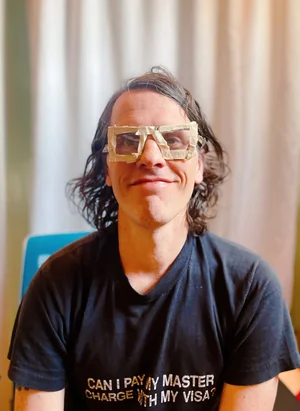
Episode 35: James Harper
James Harper: So I booked a flight to Kolkata and I think I entered on the day of my visa and I think I left on the day of my visa. The day my visa expired. And in between that time was this kind of transformation where I never went back to London to work and I went on a completely different path.
Josh Caldwell: Atypical daydreamers, welcome to the show. My guest today is James Harper. I believe the cornerstone of any great origin story is rejecting the status quo and instead pursuing what truly works. Today, James takes us on the road less traveled, biking through India, where he discovers his true north.
James Harper: It was a choice that my rational brain made, but it wasn't really my emotional side. I remember a conversation around the dinner table with my folks, and I said, I want to pursue music after school. I want to apply to music universities. And they said, I don't know about that. Can you make a career in music? It's very risky. And nobody I knew, I had no creative friends. They were all sons and daughters of bankers and ambassadors and politicians. They all went off to do very important things like studying economics or political science. And so I didn't really have the confidence in myself to say no, I really want to pursue music.
I loved history but then I was like, history, that's not really useful enough. That's not what the global economy needs right now. So I found a course at York University which offered economic history. I said, okay, great. You have the history, which will be fun and interesting. And then you have the economics, which will be like an add-on. I'll learn some stuff and that's useful for the job market. I don't know if you know anything about economic history, but it's extremely dull. It's the driest way to look back at history because it's just numbers. A complete lack of story.
I kind of went with the flow again and chose to get a career in finance to start off with. But my god, it was so dry. I just couldn't relate to the people, the personalities. There's so much to see in the world, so much to explore. I'm like 22, for god's sake. And I can see myself in 20 years. I look at the corner of the office, the corner of the floor, and there's like the head of department. And if I knuckle down and work hard for the next 20 years in this environment, I might become that person. And I'm like, but that's my youth. There's so much about the world I want to explore. This can't be it.
Before I knew it, I started making decisions that led me down a path to just quitting. I don't know what I want to do, but I want to just have more of an adventure. When I told my friends I was going to quit and go traveling, they thought I was a bit crazy. Can you do that? Is that allowed? So basically I saved a bunch of cash. I had my first six months planned out.
James Harper: The first thing I did was go to Budapest, where I was gonna learn how to get an English teaching qualification, the CELTA. Did that, and then went to Africa and explored parts of it, Kenya and South Africa. And then I had three and a half months in the jungles of Borneo. Then the idea was to go to China, because China is where everything happens. China was growing so fast, it was the future of the world. So you gotta learn Chinese, you gotta go teach English in China and find some way into industry and then make your millions.
It got to the end of the year and the moment came to hop on a flight to China. And something about it just wasn't pulling me there anymore. After six months on the road, just wasn't pulling me. But my brother at the time was traveling through India. He and I weren't very close anymore. In fact, we hadn't really been close since we were ten, although we grew up together. We were very different people. He's very spiritual, very intuitive, driven by the heart. And I'm very much the opposite of that. Very logical and strategic. But here was this opportunity where we were both young adults just to be in the same place in a different part of the world. He was in India, just across the border. I was like, well, maybe this is a sign. China can wait a little bit.
So I booked a flight to Kolkata and I think I entered on the day of my visa and I think I left on the day of my visa. The day my visa expired. And in between that time was this kind of transformation where I never went back to London to work and I went on a completely different path.
James Harper: So my brother and I, we had a lot of ice to break after many years. It took many, many conversations before we were finally just somewhat loose and comfortable around each other. We had gone to Nepal, actually, and as we were walking around, I came across a traveler who had this motorcycle, a Royal Enfield. It's a British motorcycle made in the 1950s in this very distinctive style. Think of it like the British version of a Harley Davidson. In India they're everywhere because they bought the rights to make this one model from the 1950s and they just keep making tens of thousands of them. So there are loads of them floating around.
And this one person I met while traveling through Nepal, he had one. I said, so you motorcycled across India? He said, I did. Interesting. And a challenge emerged. Well, could I get a motorcycle and survive India on a motorcycle? And for context, I've never ridden a motorcycle. I didn't have a license. But it's India. Come on. It's part of the fun. We'll make it work.
So I made my way down to Delhi and stayed in this god awful, horrendous part of town called Paharganj. I went down to the area of Delhi that's just full of motorcycle vendors. I had no idea how these things worked. I mean, I'd ridden a motorcycle once or twice before at this point in Nepal, but these were 350cc heavy things going extremely fast. You could kill yourself easily. The sort of thing where if you try to kickstart it with the lever and you're not careful, it springs back up, your knee flies up, and if you have your handlebars in the wrong place, you've broken your knee. It was hot, dusty, grimy on these streets and noisy. Because these things are loud.
James Harper: Basically, I learned how to ride an Enfield by just trialing them out from these different dealers. When I first did it, there was a crowd. There's always a crowd around you, especially as a Westerner in India. So they taught me the basics on how to operate this thing. And I paid money for it, like six or seven hundred dollars. Not that much. Off I went on what would become a three-month journey from Delhi all the way down to Chennai. I think it was well over a thousand kilometers, on a level of infrastructure which back then in 2014 was not like India today where you have highways and stuff. It was rough.
So there was a time I almost died. I was motorcycling in Rajasthan. It was a very narrow highway. There's sand on either side. Two trucks coming towards me. What was happening was a big truck was overtaking another big truck. These trucks are incredibly slow, so it was gonna take maybe two minutes for this truck to overtake the other. But I was in my lane. I'm listening to this podcast by this French guy droning on. And the truck flashes the lights. It's getting closer. I'm like, but dude, I'm not moving. Get out of the way. He flashes again and we're getting really close. And then it hits me. The rules of the road in India are that the biggest vehicle sets the rules. And I was a motorcycle against a truck. So I slam on the brake as hard as I can and hurl the bike into the sand.
James Harper: Immediately the bike flips over. I go flying. And fortunately I kind of fallen onto the sand and flown back onto the tarmac as those trucks had gone past me. And I was screaming bloody murder. I was so angry. Oh my god. It's like learning the rules, you know. I was really shaken up. I collected myself. Then I kind of wheeled my bike along the highway because what else are you gonna do? It's the middle of nowhere. I found this one guy who was repairing his truck underneath. I said, excuse me, can you please help me? My bike's messed up. And he said, sure. He got out this metal rod, pried it around, hit a couple of things, chink, chink, chink. Done, working again. My god, how much do I owe you? He said like seventy cents. Here, take more.
So off I got back on the bike. And it was really scary because literally almost an hour later I came across a scene. Every time you see a group of people on the roads of India, you know something bad's gone down. And yeah, someone had come off their vehicle and they'd splat it across the road. And I'm like, that could have been me an hour ago.
Josh Caldwell: Hey, it's Josh. Hope you're enjoying the podcast. And if so, are you wanting more road stories? Well, good news. I've got you covered. Consider becoming a patron. You'll have access to loads of great bonus stories that there just wasn't time for. And you'll be supporting a truly independent podcast. Find the link in the show notes and thanks. Now back to the show.
James Harper: The journey continues. I went further and further south, ended up near the Pakistani border, just kind of gate crashing a Hindu Muslim festival in the middle of the desert. I became the guest of honor, bestowing gifts and hats to these extraordinary tabla players. And going on these rides which had just been sprung up in the middle of the desert, powered by generators. Health and safety, it just looked so dangerous. But well, you live once. You gotta give it a try. And I made my way further south, ended up on a Bollywood film set, because that's what you do. And then almost froze to death during the monsoons and had to get out of a park before it closed before I got eaten by lions, and got arrested for trespassing in Auroville, a hippie hotspot in the south of India. So that was that.
Three months is up. I have a month and a half left of my visa. I'm not interested in motorcycling across India further. I think I'm done. I've had enough experiences. Thank you very much. But now what? The big issue I'd been facing this entire time was, well, where do I go in my life now? I left finance. I thought I was still gonna go back into finance. I didn't want to start work immediately, but I needed to at least have a direction. But I couldn't really figure it out. I had many different competing things.
And then this crazy idea popped up. Maybe I should just give coffee a bash. The coffee industry. But what a ridiculous idea that is. Coffee. Back in London, coffee was the thing that gave me so much joy. Any opportunity I could, I'd go down to all the specialty coffee cafes that were popping up around London. And the vibe, the energy, the baristas, the flavors of the coffee. It's such a cool, fascinating industry with so many connections across the world and in history. But then I was like, that's not a career. I got friends who are getting promoted to this and that, running departments, earning big bucks. And what, I'm gonna work as a barista? This is ridiculous. So I scuffled the idea. But I still didn't know what I wanted to do.
James Harper: And then it was like, okay, I have a month and a half left on my visa. I really have no idea where I wanna go next. And I had heard that there was a window if you want to cycle through Kashmir on a bicycle. And I thought, well, I've just been through some crazy shit on the motorcycle not really knowing what I was doing and kind of survived. So let's push it again. Let's hop on a push bike and go through Kashmir and see what happens.
So that's what I did. I sold the motorcycle, bought a bicycle, made a friend at the bicycle shop in Delhi who also wanted to do the trip with me. We set off on the bus to Srinagar, which is the capital of Kashmir. Very strange. You get there, it's full of police everywhere, military police, the military themselves. And then from there, just began cycling up, up, up and up. It was gonna be two or three weeks of just mountain passes of like four or five thousand meters high. You would easily do two thousand meters of ascent in a day, get up to like four and a half thousand meters and then kind of go down again.
Quite limited infrastructure. No hostels, not that many restaurants. You'd be lucky if every fifty kilometers there was a dabba. Some local people who basically set up a tent with some carpets, some daal, and you'd cycle in, eat the daal, sleep on the carpets, get up the next morning, get off.
My friend had a medical problem at one point, some kind of stomach pain. So he wasn't up for continuing with me. So we hitchhiked on a filthy truck covered in goat's milk. This was a goat's milk delivery to a military base where we put our bikes in the back and they fell over and got kind of absorbed in all this fermenting goat milk. And the guy driving the truck was super high on hashish. And at one point he was like, do you want to drive this truck?
James Harper: So I was driving this truck. It's a rocky road and there's a steep cutoff all the way down to the valley. If you fall over, you're dead. There's no coming back from that. And then it's all going fine. And then there's another truck coming along and we need to somehow get past each other. So you put your wheel right on the edge of the mountain cliff, and this truck goes right on the edge on the side of the mountain, and there's still not enough space. So you're like, well, let me just give it a few more inches off the edge. You just sneak past. I did that once and I'm like, right, no more. I'm not doing that again. You can take the wheel. And then my Indian friend, the first thing he did was he didn't realize it was in reverse. So he slammed on the accelerator and we went backwards. We almost fell off the cliff.
So at one point I'm by myself. And I'd set a deadline for myself. By the end of June, by the final day of my visa in India, which is only like a week away, I will have figured out direction. Where the hell I'm gonna go in life.
This entire time, there are only really two things keeping me company. I'm listening to the audiobook of Bill Bryson's A Short History of Nearly Everything. He basically shows all the ways in which the world has been destroyed up until now. And there are many times when most of living life was just wiped off the face of the planet. And it just really gave me this sense of, wow, the world has just been changed so much. It's so impermanent. Everything is so impermanent. At the same time, at night, I had Richard Dawkins, The God Delusion. These ideas were really percolating in my head as I was ruminating on the question, where to go next?
James Harper: Maybe it was after six months of just being disconnected from the world I'd come from, that London finance world. Honestly, I could have been on Mars. I had no influence from that world. And at this point, the only voices in my head were basically family. My grandfather, one of Australia's first and most successful investment bankers. My dad also. He was all about free market capitalism. It's all about scale, grow, disrupt, blah, blah, blah. And so the idea of me doing something coffee related was just ridiculous in that context.
The more I stood on it, cycling up there in these high altitude deserts, the more I was just like, well, this is dumb. I mean, everything here is so impermanent. These ideas that they have are so impermanent. Fine, they matter now, but they're not gonna matter in twenty years, they're not gonna matter in a hundred years. In fact, my grandfather had passed away while I was in India. And that whole value set to some extent goes with him, right? So what really matters is, well, what do I want? What do I care about? I'm in it for the journey. I'm in it for the exploration and just seeing where it takes me.
And so I came off that mountain with a direction. The direction was coffee. Quite how and what, I wasn't quite sure, but at least I had a direction to travel in.
Josh Caldwell: I want to thank James for sharing his experiences. Be sure to check out his podcast, Filter Stories, a documentary podcast featuring coffee stories with an extra shot of history and science. This podcast is created and produced by me, Josh Caldwell. Music by Visual Aid, my side music project. General support and copywriting by Miranda Caldwell. And if you know someone who you think might enjoy this show, send them this episode. The support really helps. Thank you for listening. And I hope you come back next time.