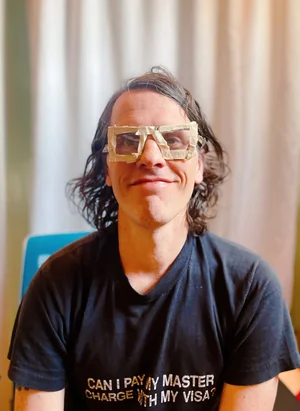
Episode 29: Patrick Caldwell & Jeffrey Martin
Patrick Caldwell: You get out there and you realize there are other people out there and you make all these, everything's an assumption. But when you get out there, there's no assumptions, it's reality. And you realize, wow, people have it really tough.
Josh Caldwell: Hello, my atypical daydreamers. Welcome to the show. My first guest is Patrick Caldwell. And yes, we are related. He's one of my older brothers, the one that hitchhiked all over the US in the mid-80s. Today, Patrick pulls back the curtain to expose the wild underbelly of the road.
Patrick Caldwell: When I graduated from high school, I had no desire but all the expectation to go to school after that. But I had no idea what I was gonna do. And at that time I thought I could be a musician. So my friend Judd, the only guy we know that actually became a musician out of all of us, he wanted to go out and start making music. So we took our guitars and had Joe drive us to the edge of town headed west and we just hitchhiked. And that was the thing. We were just going to go out. There was no plan, really. This is leave. I'm on my own. There's no rule. There's nothing we have to do.
Now I'm talking from a place of privilege. I mean, I know that I'm white and male in the United States, middle class. So with all that caveat, I do think that if you're given the chance, that's the way to go. So we left and we just started going. And the one plan we did have was to hit the coastal highway in California. That got smushed because we realized you can't hitchhike on that highway.
But long before that, we went through West Texas, then we headed into Colorado, and then we rode up through Nevada. We ended up in the most northwest in Idaho. And then we headed across just right across the top of the Dakotas and made sure we went through the Badlands. Then we ended up in Chicago and came down to Champaign, Illinois. Then we actually took a bus from there down to New Orleans. And then we hitchhiked back from New Orleans to Austin.
What I realized when you go out there is being out there among people that you realize, oh my god, people have it really tough. And I think that everybody stays home and you're safe. But when you put yourself out there where you're not in a home, you realize one, it gives me not a respect in a good way, you know, a guy who's an alcoholic living on the street, you have to be really, really strong to make that. You can't do that unless you're tough. And there are people out there who will help you. Typically those are either religious or they've already done their hitchhiking on their own. And then there's just a lot of really psychotic and scary people out there on the road.
Patrick Caldwell: Out of that, one of my favorites was we got stuck out in West Texas. One guy was driving us, I can't remember why we got out of the car with him. I think he was going the other direction. But he let us out in the middle of nowhere. I mean, there was nobody there. Hitchhiking is a numbers game, right? A thousand cars go by, you get one. So if it takes 40 hours to see a thousand cars, you slow down. But we were stuck by the side of the road and this beautiful Cadillac pulls up and offers us a ride. So we say yeah, obviously, and we jump in.
So there's a man and a woman up front. The man is red-haired and he looks like Santa Claus but with red hair. I mean, literally that's Santa Claus. Same age, same everything. And the lady, she just looked the same age, short hair, nothing discernible. She wasn't Miss Santa Claus or anything. She was just a lady there.
So they said, hey, there's beer and food back there if you want any. Perfect, right? And we opened up the food thing though, and it was Mexican food that had been sitting there for several days. Just rotting food. But yeah, there was a lot of beer. So we started drinking beer and they were obviously very intoxicated already. But out there, I mean, it's like there's no one there. These wide, wide highways. There's nobody around and it was nighttime. So most people are home.
Patrick Caldwell: So we were driving. It was like dusk so we could still see and the lady proceeds to take her top off. And it was just like matter of fact, right? She took her top off. It wasn't interacting with us or anything. She turned around and she started talking to us. She said, I'm dying. And then she did this with her fingers on her mouth and showed us it was bleeding. Blood was in her mouth. I'm giving Red this car if he'll drive me to Amarillo. So Red's along for the ride simply to get the free car. So she says, you know, I've been dying and I put my son through college and then medical school. And then he basically just wrote me out of his life. It was a very sad story. And that went on for at least 30 minutes. Red's driving like 40 miles an hour. He's driving really slow. And then she remembers, she looks up and she looks at Judd and she goes, you remind me exactly of my son. So that was weird. And so there was a lot of talking directly at Judd, and I think there's some judgment of Judd.
The overall thing lasted like four hours that we were driving with this guy, because it got dark as we were going. But then the conversation went a little darker, and she never said murder, but you get the feel that this woman was heading towards something about murder, but it didn't really make any sense. She was just talking. Then she said, you're going to be safe. We're going to take you to the devil's back acre and drop you off, but you're going to be safe.
I mean, these people were short. You know, Santa Claus is short, right? So Red is a short old guy and she's probably in her late 60s and very short too. So physically, unless they had guns, we could have fought them off or whatever, but it was getting really dark. And so I think then Red put the radio on and they played some country music. And so it quieted down for a little while. And then we see her slowly put her head down.
Patrick Caldwell: Into Red's crotch. She started to give him a blowjob right there in the car. And the fun thing was, Red started going much faster. He was going 40 miles an hour. He got up to about 75 miles an hour and the white lights of the beams are going off in the darkness. He finishes obviously because then he slows down. It's like a bad movie or a bad porno or a bad song.
We come to some little corner stop store and they say, we get some more beer. So they pull in and stop, leave the car running. Both of them go into the store. And then we hear this screeching. This truck comes in and slams directly into the utility pole right there. Bam. Huge sound, probably 20 feet away from us. And the guy just gets out and goes in the store.
I never saw him come out because our drivers came back out and took us to the devil's back acre and let us go. And then I'm assuming he got his car and she died in Amarillo. And that was early on. So that was a really good precursor for what the road was going to be. Because when you're 19 or whatever, you also don't think you're ever going to die or anything. And I was like, this is really fun.
I remember we used to ride on the top of the car when people would drive. You're just an idiot when you're that age.
Josh Caldwell: Hey, Josh here. I love making this podcast and I'd love to make it my full-time gig. Besides telling the stories, I'm basically a one-man band and that takes time. If you're enjoying the podcast, please consider becoming a patron. You'll have access to loads of great bonus stories and you'll have the satisfaction of knowing that you're supporting a truly independent podcast. Find the Patreon link in the show notes. And thanks.
My next guest is Jeffrey Martin. He's a photographer and his company builds cameras for mapping and 3D scanning. Think Google Street View. Jeffrey takes us on a strange trip with unique heights and a very strange and dark low. And a warning, this next story contains graphic descriptions that are not suitable for the squeamish.
Jeffrey Martin: So I've traveled to a lot of places in order to take a massive, huge photograph, usually from the top of a tall building in some city. I've been to Japan, Rome, London, Barcelona, all kinds of major cities. I'd be up on some kind of tall building at the top for maybe all day or two or three full days, taking like thousands of photos of the cityscape and then putting them all together into a single huge photo. Spend a few weeks stitching it all together. Of course, if you have a long zoom lens and you're doing lots of shots in a city, you get shots that are through windows and stuff. And you don't want to unduly embarrass somebody or something like that. So I try to check these photos before I publish them online for anything weird.
I know someone else who made one in Paris and they found a gun on a roof and they told the police and the police went and got the gun. In my case, I was shooting one of these gigapixel images in London and I was stitching it together and checking it. I'd been working on it for like a couple of months and then finally it was almost done. I zoomed in to 100 percent and was checking the whole image and I found a naked woman in a bathroom. It was on this roof apartment, all glass, and the bathroom was all glass with no curtains. I think they figured they're on the top floor of the neighborhood and didn't count on someone with a 200 millimeter lens from a quarter of a mile away. So I blurred her out, but it was like the back of her.
Jeffrey Martin: So I was in Mexico in 2001, Guatemala, Mexico. My friend and I wanted to cover a kind of freaky Catholic Mexican faith healer event in a village near Monterey called Espinoza, which means the spine. So if you've been to Mexico, these Catholics don't seem very Catholic compared to Catholics in the US or Europe. There's a lot of weird magic stuff and kind of witchy stuff. There was this faith healer guy in the 1920s called Nino Fidencio who I guess did some miracles and cured people. And now there's this annual kind of pilgrimage where they like crawl down the street or roll down the street or go on their knees or something to punish themselves because they're Catholic and they have to do that.
So my friend wanted to write an article to sell to the New Yorker and I would take the photos. So that was the big plan. I met him in Guatemala and we took buses from Guatemala through Chiapas and all the way through Mexico to the very north and then back again. So we were in Oaxaca. We were looking for some weed. And we found someone who said, meet us on the church steps at eight o'clock.
So we go to the church steps and there's some other guy there waiting on the church steps. We figure he's waiting for the same people. And so we started talking to him. His name was Ben and he had this big scar on his forehead, like right in the middle, a serious gouge kind of scar. My friend is a journalist so he's pretty good at just asking questions. And so finally we asked him, okay, what's this scar in your forehead?
And then he told us this story. He was from Florida and he was already in Oaxaca with no passport and he was on his way to Brazil, to the jungle, to eat ayahuasca, which he had been cultivating in Florida for quite a while. I've never done ayahuasca, but apparently there are like machine elves or some other beings in a parallel world to ours. So he'd been in communication with them for quite a while and they told him to drill a hole in his head. And it was something to do with like infiltrating the political system in the US.
Jeffrey Martin: So anyway, he took a hand drill and you know, like when you're drilling a hole into a piece of wood and then it's resisting and then it goes through. So he did that and it went in too deep into his brain and then he pulled it out and there was like a chunk of brain there and quite a bit of blood. And I don't know, he put it down and he said his dog ate the brain.
But yeah, I've always wondered if he ever made it to Brazil and what the vine told him to do next.
Josh Caldwell: I want to thank Patrick and Jeffrey for sharing their experience. This podcast was created and produced by me, Josh Caldwell. Music by Visual Aid, my side music project. General support and copywriting by Miranda Caldwell. If you like the show, please follow, subscribe, rate, and review wherever you listen to podcasts. And if you'd like to financially support the show, check out my Patreon page. You'll have access to loads of great bonus stories. Thank you for listening, and I hope you come back next week.