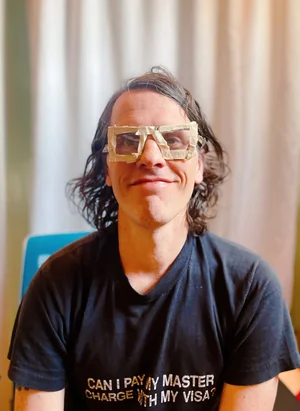
Episode 12: Kent Adamson & Katy Cox
Kent Adamson: So this happened a couple times and then finally Fuller pointed the gun at him and he says, if you do that one more time, I'm going to kill you.
Josh Caldwell: Welcome to Atypical Daydream, a podcast about life on the road. I'm Josh, your host, and thanks for stopping by. My first guest is Kent Adamson. He's a producer and a writer living in Los Angeles, California. In all the years that I've known Kent, he's never run out of great stories, and this episode is no exception. High in the mountains above LA, Kent shows us what it takes to stay cool among Hollywood royalty.
Kent Adamson: The first day I met legendary American film director Samuel Fuller, an action man, was when he was shooting his first opening day shoot for The Big Red One in the late 70s. We went up to Snow Valley, which is a really beautiful ski resort, but it was doubling for Nazi Germany. And it was the biggest set I'd ever been on at that point because it was an A movie budget union set.
I didn't know what to expect. I had never met Fuller before. I had seen his movies a zillion times and he had made many great ones in the sixties and seventies. He was still working in Europe and Hollywood. He had also become a legend in the revival houses for movies like The Naked Kiss, Shock Corridor, Crimson Kimono — one of Robert Ryan's best films. Just these amazing movies. My favorite was always Pick Up on South Street.
As you drove up to this set, it's a long drive up the hill. Snow Valley is about halfway between Big Bear and Arrowhead Lake. You kind of wind your way up this hill — it's way up in the elevation. In Germany or Switzerland, people just fall off a hill into a deep valley and they're dead, they never come back. All the way up and down the hills you see these little crosses of people that didn't make it. Going to Snow Valley was a little different because it's California. People don't really fall right off it, they just slide off because it's icy. When you're going up this hill, you're kind of not too sure if you're really gonna make it when it's snowy and it was.
I finally got up to the top of the hill and there was Snow Valley. And the next thing I knew I was pulling in behind these giant studio trucks that had tracked up this giant hill with big trailers that had Nazi Panzers on them and all kinds of film equipment — C stands, the cameras, everything. This was a big union shoot. All the guys that drove the trucks from the studio up to this location were union guys. They were already done because they did the drive and they were sitting in the back of the trucks with little card tables playing cards, which is what they did for the next ten hours.
What they were doing was getting these little walking scenes of the American GIs. Fuller had been in the First Division of the Army — that's the Big Red One. He had a lighter with a Big Red One on it. Those guys were super proud because they were the first guys into something. Fuller was trying to capture his sense of it, which was kind of artistic and also very action oriented. He had gotten a great cast together — Mark Hamill right off of Star Wars, and Lee Marvin committed to the lead role. It was a very interesting script and it had been around for a while. Eventually Gene Corman came in — the brother of Roger Corman and a partner in New World Pictures, which at that time was going full bore. They had both started in drive-in movies in the 50s, working for American International making horror movies, Vincent Price, Edgar Allan Poe films. So they said, well, you should meet Sam Fuller. And I was like, yeah, that sounds great.
Kent Adamson: He was noted as a tough guy writer who wrote great, very active action movies that are gripping. He was intimidating in his legend, but when you meet him, he walks up to you and he's like the nicest guy in the world. He was like, hey young man, how are you? Thanks for coming to my set. Why are you interested in this old man? And I said, well, you're just a legend. He goes, no, I'm not.
But he was reputed to always carry a pearl-handled pistol on the set to call action and to solve any problems. That was his rep. But he was really a big sweetheart and a nice guy. At the set he had his wife Krista, who was amazing — a wonderful German woman who'd played in Alphaville by Godard with Akim Tamiroff. That was legendary. And then they had their wonderful daughter who was only two years old, Samantha. The main thing they had to do with Samantha was just keep her quiet because she loved her daddy. When he was directing, she just wanted to run over and give him a hug and say, daddy, what are you doing?
Plus the press was there because this was his first day shooting. They had Time Magazine and all these guys who took up a whole table at lunch. Very exciting all the way around. And as long as you left the crew alone — who were playing cards in the trucks — no problem. They'd say, whatever you do, don't bother the teamsters. I didn't even know what that meant, but I was like, okay, I won't. And then also Lee Marvin was there and they'd say, don't bother Lee Marvin. Just leave him alone. That's the best thing you can do with Lee. So I was like, okay, whatever. I was just a kid, probably about 19. Anything they said to do — it's a big set, you don't want to get in trouble.
At one point they started yelling for people to shovel snow. They were going to shoot the section where the American GIs were hiding down below a little snow bank as these big Nazi Panzers drove by. They'd gotten those things off their trailers and they were actually running — noisy tanks rolling by. So it was a great shot. They shot for quite a while, all the entire day.
They broke for lunch with all the press where they interviewed Fuller, who was absolutely on. He had his pearl-handled revolver and he flashed it around. And Roger Corman had sent over a first AD who was very aggressive. This guy was kind of a legend in the Corman world because he had sued his way into the Director's Guild. Nobody could get in the Director's Guild unless they were related to somebody, but this guy came out of nowhere and sued them and said it's a restraint of trade. They let him in. The Cormans loved stuff like that — tough guy made his claim and won. So they put him on the picture.
The thing was, when Fuller was ready to shoot, he called action with his revolver — he pointed it in the air and fired it off. Well, this AD in subsequent shots would call action ahead of Fuller shooting. He'd go, action! And everybody would look at him and then Fuller would shoot the gun. So this happened a couple of times and then finally Fuller pointed the gun at him and said, if you do that one more time, I'm going to kill you. Now his gun only had blanks. That was his sense of humor. And you can feel it in his films. It was an amazing day. One of my favorite days of my entire life.
But I thought — cinephile obligations — I kind of have to say hello to Lee Marvin. So I was going to ask somebody because they told me not to say anything. He'd been standing over in this snowbank by himself most of the time. He didn't eat lunch. They said he has a cold and he's in a bad mood. Plus he's Lee Marvin. At that time he was probably one of the most macho actors and had been for decades — all the way back to working with Brando in The Wild One. He was always like, tougher than Brando macho dude. And so everyone was in awe of him. He wouldn't talk, which made it even more interesting.
Kent Adamson: As I watched him, I realized that this big macho guy was smoking these long thin cigarettes that were mainly marketed to society women, called Mores. You'd go to a party and see very elegant women smoking these Mores at a screening or something like that. And so it was just this weird disjunction — the most macho actor in the world smoking these cigarettes. I thought, well, maybe he's cooler than these people are saying.
So finally I trudged over there towards the end of the day after he'd done his bits and retreated to his favorite spot and wouldn't talk to anybody. And I just said, hello Mr. Marvin, it's an honor to meet you. I just wanted to say how much I have always appreciated your work — you know, all the wrong things to say. So he just looked at me with this stare like he was going to hit me. Total deadpan. Now I'm getting scared. And he didn't say anything. He just leaned his head back, put his finger on one nostril, thrust his head forward, and blew a giant wad of snot in the snow. And that's all he had to say to me. I was like, well, hey, that's actually pretty cool coming from Lee Marvin. I felt great about it. And it was really better than a handshake from a guy with a cold anyway, right?
Josh Caldwell: Hey, Josh here. I love making this podcast and I'd love to make it my full-time gig. Besides telling the stories, I'm basically a one-man band and that takes time. If you're enjoying the podcast, please consider becoming a patron. You'll have access to loads of great bonus stories and you'll have the satisfaction of knowing that you're supporting a truly independent podcast. Find the Patreon link in the show notes. And thanks.
This next story comes from Katy Cox. She's a bowmaker and plays a mean fiddle. Katy's story takes us to both sides of the touring rainbow, from ragtag to the riches of the road.
Katy Cox: I play fiddle and I got into touring. I was living in New York City and I had a job that was really cool but I didn't really want to do it. I had this assistant position for a manager who managed opera singers, stage directors, and conductors. The agency was Columbia Artist Management, called CAMI. Part of my job was to arrange all the work visas and the airplane tickets and all of that for these amazingly talented musicians. And it would drive me nuts because I wanted to be on the other end of that. So that's what kind of sparked my initial pursuit.
At the same time I met this guy named Izzy Zademan and he wanted to start a speed metal punk rock bluegrass band. He had the brilliant name — which I'm slightly horrified by now — but he called the band Uncle Fucker. We had dancers called the Fuckerettes and everybody wore matching purple metallic, slutty outfits that were cowboy themed with fringe and all of that. And so this was my bold move into the world of the unknown of touring.
He would book these tours. He would somehow find these sketchy vehicles on Craigslist and buy them. One of them was this bus. Him and his carpenter buddies built out all these bunk beds in there. I was the fiddle player in the band. The dancers were female, everyone else was male. So in the beginning it was just me and a bunch of dudes. They were all young and super hungry to just get out there and party and live like rock stars.
One time he was just adamant on having a banjo player. So in addition to finding this bus on Craigslist, he found a banjo player on Craigslist. We didn't know really anything about him. He booked some weird tour all the way down to Georgia, actually down to Florida, and then back to New York. I didn't know where I was going. We didn't know how much money we were making. We were just doing it.
Katy Cox: How we would find places to crash — we would either sleep in the bus or one of the guys would pick a girl in the audience and hook up with that girl and that poor girl just had to have all of us sleeping in her living room. I mean, this bus was disgusting. These guys would pee in water bottles and the bottles were all rolling around. This is the roughest tour I've ever had. I don't think we ever showered. It was just disgusting.
One night in particular I wanted to get into a motel. I got a cab and found a motel and told them where I was going. Everyone got really drunk and crashed out in the bus except for me. Well, the next morning the banjo player — who we didn't know — took the bus and just decided he was going to start driving it, even though he was blasted. He drove it in the middle of the night through a car wash that wasn't prepared for a giant bus.
Katy Cox: He destroyed the bus and the car wash, and then we were stranded in Savannah, Georgia. The next day, the banjo player disappeared. He was so ashamed and horrified. He got his banjo and his bag and we never heard from him again. I never saw this man ever again.
The car wash owners and the police came and somehow these guys got off the hook. I was not there. Then we found a place to crash from one of the fans, this guy named Russ, who was a skinhead — and he was very nice apart from being a skinhead. I remember him very well because he introduced me to a Jäger bomber, and he used to think it was hilarious to spit out his teeth, flip them with his tongue, and suck his teeth back in.
That was probably the roughest, craziest touring I've ever done. I was so past my comfort zone that it really cracked me open as a musician. I feel like I'm a very shy person, but every once in a while that wall comes down and I can really perform. I owe a lot of that wall coming down to that band.
Another band I was in toured multiple times through Germany and they just do it right there. Man, they do it right. This band was a trio called Shotgun Party and the tours we would do were called the Bluegrass Jamboree. This man named Reiner Zellner, who's a major bluegrass fan, would assemble and promote these tours. He arranged all the details. We would always have a really clean hotel room every night. We would always have meals ready when we needed to eat. All of our transportation was taken care of. He did all the promotion. Honestly, once I got to this point I was like, this is what I originally wanted. Not the Uncle Fucker reality — though that was valuable.
I always thought that a good industry would be a therapist who specializes in being a therapist for a band or any kind of traveling group, because you're sharing the same space and clocking a lot of time when you're bored together. What a way to get to know people. You've got to figure out how to put up some kind of invisible wall to feel your privacy while breathing the same air, coming up with new things to talk about. You start to know that the bass player smacks a lot. All their little things. And that makes it so that you actually become extended family. You get close, you argue, and you get through those arguments. Playing music and being in a van day in and day out — you're forced to figure out how to get through conflict. I really appreciate that. Every single person I've ever been in a band with I am still connected to forever.
Michael Cleven — I feel that with him and he's freaking playing at the Grammys and doing all this stuff. If you don't know who this guy is, you should look him up. He is seriously probably one of the best fiddle players on the planet. He holds his bow like a baseball bat, he is blind, he's got a harelip, and I think he's deaf in one ear. And I saw him when he was a kid at a Bluegrass Festival and I couldn't believe it. I couldn't believe this person.
Katy Cox: My band opened up for his band and we were in the same bus for a little over a month. We played shows every night and he would sit and play music with me for hours. And I treasure that time deeply. Also just getting to know Germany — it was my first time there. I remember sitting bored with him before a show and they gave us this bowl of gummy bears. And since he's blind I was like, okay, let's see if gummy bears really do have different flavors. So I put out all the gummy bears and we did a taste test. And apparently the only one that tastes different is the white, just so you know.
Josh Caldwell: I want to thank Kent and Katy for sharing their experiences. Make sure to check out Katy's band Tiger Alley. You can find them on Instagram at Tiger Alley Music. Links in the show notes. This podcast was created and produced by me, Josh Caldwell. Music by Visual Aid, my side music project. General support and copywriting by Miranda Caldwell. If you like the show, please follow, subscribe, rate, and review wherever you listen to podcasts. And if you'd like to financially support the show, check out my Patreon page. You'll have access to loads of great bonus stories. You can find the link in the show notes. Thank you for listening, and I hope you come back next week.