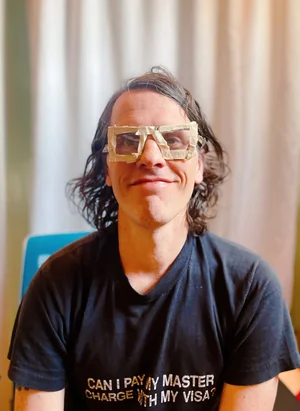
Episode 11: Scout McComb
Scout McComb: They are so mad they bust open the doors, they trash it, start — whoever was there must have taken off. I mean, they would have been killed. Like if somebody was there, there was bloodlust in this mob.
Josh Caldwell: Welcome to Atypical Daydream, a podcast about life on the road. I'm Josh, your host, and thanks for stopping by. My guest today is Scout McComb. He's an artist and a writer building a sculpture garden in the West Texas desert. Scout is an old friend and someone who I've been on many adventures with. His stories take us deep into the heart of Guatemala, from jungles to highlands, embracing both the lightness and the darkness.
Scout McComb: The first thing I think about when I think of Guatemala is itself kind of a story. I'd asked if you remembered that book, The Celestine Prophecy, which you did. I want to say that was the mid to late 90s. The thesis of the book, really boiled down, was a group of people on a voyage of inner discovery. At the end of that voyage, they were going to find out how to transcend this earthly plane and go to paradise. It was kind of like a New Age version of how to get to heaven. And that was really in the ether back then. The New Age movement of the 90s was all about transcending life somehow. In The Celestine Prophecy and in that New Age world at large, they always used this idea that the Mayan civilization just vanished. Like one day there was this civilization and they just vibrated to the point where they vanished and went to some higher plane.
I must have been in high school when I read that and I kind of bought into it. In my Yankee localism kind of way I thought of Guatemala as just kind of being like Mexico — like south of Laredo it's Mexico all the way down to the tip of South America. I traveled a lot in Mexico and Mexico is an amazing place. I just thought it was amazing all the way down, but in a Mexico way. I didn't really think that everything's different there — as different from Mexico as Poland is different from the US.
So when I read The Celestine Prophecy, I thought of the Mayan civilization as being this paragon of spiritual transcendence. One of the things that shocked me when I first went down there — that apparently nobody told me — was that the Mayans are all still there.
And that's not a disappointment. I thought they had transcended. No — it was amazing. I was gobsmacked that I literally thought it was going to be this mestizo culture, like Mexico. But then you start getting out into Guatemala and you realize — who are these people wearing traditional textiles and speaking almost like click languages? I thought they spoke Spanish down here. My shock very quickly turned to absolute wonder, amazement, respect, and humility the deeper I got into Guatemala. Not only is the Mayan civilization still there, but they are thriving in many ways.
I did get caught up in something. I was in some village way back in the bush, in the Highland region. A Mayan village. I was sitting out on the stoop reading a book. It was getting dark and all of a sudden a huge throng of people came running in front of me — all dudes, and they looked really mad. Maybe 150, something like that. Must have been almost everyone in the village. My first thought was, dude, I gotta run with them. I gotta see what this is. So I threw my book to the side and just started running.
Scout McComb: In the center of the village was the mestizo administrative governmental building — not Mayan. This is like Guatemala the country. To these people it wasn't Guatemala. It was their name in Mayan for where they lived. Guatemala was just a construct. But Guatemala was there in this building.
Apparently they had passed some kind of tax or something like that. And Josh, I had the feeling that someone in Boston who lived around the harbor in the late 1700s must have felt sitting out on the steps peeling a potato when a bunch of angry people came running by to push tea off those ships because they were mad at a tax. It was the same. And so I'm running with them, we run into this building. They are so mad, they bust open the doors. This thing is maybe four stories high — the only real building there. They trash it. Whoever was there must have taken off. They would have been killed. There was bloodlust in this mob. They started throwing chairs and tables and paperwork out the windows. And then there was smoke. And essentially they started lighting the place on fire.
And I, being a fully immersive tourist as I am, and being about 19 or 20 years old, I had to get in there and light some shit on fire too. If for no other reason than to get a little taste of what it must have been like to be part of the Boston Tea Party. So they literally set this building on fire. And while it's burning, the village police and the village firemen — all volunteer, with little hats as their only signifier — just stood there smoking cigarettes, watching the whole thing happen. At a certain point the mob just burned itself out on its own anger. And then everybody went home. And then the next morning there were people out cleaning it up.
I'm a writer, so I have a taste for the remarkable moment. And that was a remarkable moment — capital R, capital M.
Josh Caldwell: Hey, Josh here. I love making this podcast and I'd love to make it my full-time gig. Besides telling the stories, I'm basically a one-man band and that takes time. If you're enjoying the podcast, please consider becoming a patron. You'll have access to loads of great bonus stories and you'll have the satisfaction of knowing that you're supporting a truly independent podcast. Find the Patreon link in the show notes. And thanks.
Scout McComb: You and I and John and a couple other people went with the dad that John was staying with — Efraim — on that trip to El Zotz, which I think was four days. Two days in and two days out. He took us back in there and on the second day we saw something that at the time I didn't realize how significant it was. But over the years, especially being an outdoors person and traveling more and knowing hunters, I've come to understand it.
We turned a corner on the trail — we're all on game trails, or Chiclero trails, the trails that Chicleros would take to get to chicle or allspice trees. Part game trail, part tiny single track. We turn the trail and right before us, maybe 20 feet away, there was not only one jaguar but two jaguars. And they were mating. Whatever instinct toward caution they must have had was completely overridden by their instinct to procreate. They didn't stop. They didn't look up and go, oh shit, we're busted, let's run. They kept mating and we watched them mate. We were all just standing still. There were no phone cameras or anything. Nobody took a picture. We're all just standing there staring. The male finishes, dismounts, and the female just lies there and rolls over on her back and rubs in the dirt. She sees us but she doesn't care. She's not scared.
Scout McComb: And then at some point she gets up and just saunters off into the jungle. I can't tell you how many people I told that story to that straight up called me a liar. In Guatemala especially, because the jaguar is a very sacred animal to the Mayan population. It's considered a huge lucky moment if you're able to see one in your life — much less two, much less mating.
Taking that trek and marrying it to the longer one we did — we went past that another few days. It was like a seven or eight day trek. We went to El Mirador, which I think was the largest known Mayan city. And all along the way we're seeing ruins of the civilization — not just every once in a while, not just once a day, but literally minute by minute we're walking by mounds. It was like if you went to Hong Kong and let it sit for a hundred thousand years and then walked through it. Yeah, there'd be plants and jungle and all that stuff, but you're in Hong Kong the whole time. That's how it was. We're in this civilization everywhere. It's everywhere.
And then on the fourth day we make it to El Mirador. We're the only people out there. No tourists, nothing. There are two park rangers, for lack of a better word. It seemed like they had gone months without seeing anybody. They were so excited to see us. So excited to see other humans.
The national bird of Guatemala is the quetzal — a beautiful, beautiful bird. Count your lucky stars if you're able to see one in the wild because they're very, very hard to come across. Well, there were quite a few in El Mirador.
Scout McComb: It was one of the first things I saw when this area kind of opened up. It's not cleared like other ruins — there are trees growing through. But there were quetzals. And it was amazing to spend the night in this place and to go up to the top of the tallest temple and to see jungle as far as the eye could see. The spirit of the Mayan civilization was just booming. You're in the epicenter of an ancient civilization — and by the way, these park rangers were essentially that civilization. This is what they're doing now.
They insisted they wanted to make us dinner. They wouldn't take no for an answer. We'd brought our own food and I did not want to eat their food. I wanted them to eat our food. I said, no, no, no, we brought plenty, we want to feed you guys, we want to give you some money. And they would not have it. They said no, you've got to let us cook for you. We don't want your money. We're just happy to see you.
So I'll never forget sitting at this table under this thatched roof, and these guards bring out these soup bowls with these characteristic gourds and potatoes you find in all the soups there, plus this meat. We're eating this meat and I'm thinking, man, they must have some chickens around here. Hey, have you seen chickens? No. Really? So where do you think they got this meat from? Maybe they hunted? I hadn't seen a deer. We saw some monkeys. I said, maybe it's monkey meat.
Scout McComb: I mean, other than monkeys there's just those quetzals. But those are an endangered species — on the UNESCO list. You can get thrown in prison for that. Surely it's not a quetzal. It's gotta be monkey meat. At some point I talked to one of the guys. I said, what is this? What are we eating? Monkeys? Deer? What is the meat? He goes, no amigo, es un quetzal.
I shouldn't laugh, but hey — this is their land. That's their sacred bird. They have guests. You kill the sacred animal for a guest. That's what you do there. That's what you do in that world. I've got to say though, it did just taste like chicken. And in a weird way it was like the perfect moment to have there in that place.
Josh Caldwell: I want to thank Scout for sharing his experiences. Make sure to check out his woodworking and overland camping social media channels — links in the show notes. This podcast was created and produced by me, Josh Caldwell. Music by Visual Aid, my side music project. General support and copywriting by Miranda Caldwell. If you like the show, please follow, subscribe, rate, and review wherever you listen to podcasts. And if you'd like to financially support the show, check out my Patreon page. You'll have access to loads of great bonus stories. You can find the link in the show notes. Thank you for listening, and I hope you come back next week.