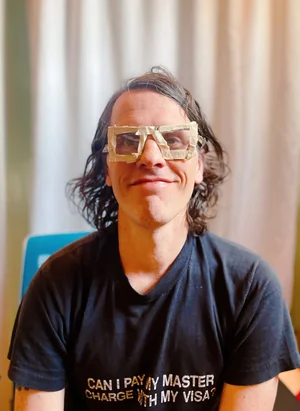
Episode 57: Flannery Foster
Flannery Foster: It doesn't make sense that safety would be my primary concern, or deter me from traveling. It's gonna happen somewhere. You gotta die for some reason.
Josh Caldwell: Hello my atypical daydreamers, welcome to the show. This is a podcast about life on the road. The comedian Pete Holmes has a joke that I love about life not making sense. But there's this one part where he says, you think you're in America? Zoom out. You're on a space rock floating in nothingness. I love this perspective. Sometimes I try to imagine the endless rivers, roads, fields, valleys, and peaks on Earth. Almost all of it I will never see. My guest today is a creative force, part entrepreneur, part artist, part educator, but above all, she's a relentless explorer. Flannery Foster isn't on a permanent vacation. She's on a mission to hit all 330 countries, colonies, territories, and exclaves on this space rock we call home. And if you're wondering how or why someone does this, stay tuned.
Flannery Foster: I was a performer. I worked in music PR. I owned ten brick and mortar locations of a yoga studio called Good Yoga in Brooklyn. I also owned a guest house, a little cafe, a guest retreat upstate in New York. And I am a travel agent, an accredited travel agent with IATAN. That's recent. And it's a result of my decision to travel to all 330 countries, colonies, territories, and exclaves. I came to that decision two and a half years ago. At that time, I had been to 135 countries, colonies, territories, and exclaves. Someone had asked me, how many are there? And I didn't know. I knew that there were 195 UN countries, five observer states. And I knew that I had been to a lot of destinations that were not UN countries. And I was interested in those places and why they weren't countries and what a colony is.
In my research, I came across a website called the Traveler's Century Club. It is a club for, from what I can glean, mostly wealthy white men who have completed at least 100 of these destinations on their compiled list of 330. Less than 30 humans had done this. And only three of them were women. Two of them had done it with their husbands. A third had been financed by her husband, but he stayed at home. Very interesting agreement. She is still alive. I believe her name is Audrey Waldman. The other two women and their husbands, all three of these women had achieved this feat when they were in their eighties.
Flannery Foster: As I'm speaking to you now, I'm 47. When I decided to count up my countries and take on this mission, I was 45. At the rate I'm going now, I'm targeting a minimum of 14 new destinations per year for the next 12 years so that I can complete the list by the time I'm 60. Yes, I would be the fourth woman. And if I get it done by 60, I might be the youngest to do it. But I will probably be the first single and self-financed woman to do it, which to me is more interesting than youngest.
So why? Why do this? One day it occurred to me, if I had all the money in the world, what would my daily life look like? And I started reverse engineering my life to get paid to do what I would pay to do. So I isolated it down to health, because without that there's nothing. Expression, art, I've always been an artist, and I now understand that I'm also firmly on the spectrum. And travel. Health is my discipline, expression is my passion, and travel is my obsession. It's the only time that I feel completely present, where everything is new and I have to be completely in this moment. There's no past, there's no future. How do I get from point A to point B? What's this new language? What's this new smell? That eventually led to me becoming a photographer.
There's a guy named Christopher Isherwood. He wrote a book called The Berlin Stories, which became a play called I Am a Camera, which became Cabaret. In the subject matter of Cabaret, he was translating Sanskrit texts for a guru who was based in Berlin. The first chapter of that book, he's likening the mind to a camera, which is actually a pretty common explanation for the yogic Buddhist way of thought. That ideally without the ego, without the eye, we're just here perceiving, with no judgment. And I find that I'm able to achieve that state more often when I'm on the road.
Flannery Foster: I guess the passion for travel started early. My father was in the military. I was born in Colorado, but before I was a year old, we were living in Germany. My mother and my older sister and I would travel. She made sure of that. From the time until I was five years old, I had traveled the Schengen states of Europe when we lived in West Germany. So by the time I was in kindergarten and in Vermont after my parents divorced, I had had an awareness of the world that the other kids in Barrie, Vermont did not.
When I was in the eighth grade, we had French exchange students visit our school. And we got to visit them. I babysat and saved up money and I also did singing telegrams so that I could pay my way to a summer in Europe. Once I moved to New York when I was 20, my first real adventure destination was in 1998 in Israel. My boyfriend at the time was Israeli. Everything I learned about Israel came from him, and he was certainly not a Zionist, though his grandfather had been one of the original occupiers of Palestine. But he was vehemently anti-war and anti-Zionism. When I was there, Syria was bombing across the border. This is where I learned that there is no more popular human on earth than Bob Marley, and that he transcends religion, he transcends politics. Most people can't understand what he's saying but the rhythm is undeniable.
Flannery Foster: We had Bob Marley playing in our car as we stopped to talk to some IDF soldiers for directions. And I saw the Israeli watchtower and I had to take a picture of it because it was painted like the Egyptian flag. And then we saw the cars coming towards us and the Israelis got a little nervous. Like, yeah, you're not allowed to take pictures of that. I thought I'd gotten us all in trouble, but the Egyptians just wanted to come hang out. So here were two countries that diplomatically were at odds, but all they wanted to talk about was Bob Marley. And ever since, in all the hundred and sixty-five places I've been, I promise you that in every political entity on earth there is a bar prominently displaying an image of Bob Marley and playing the Legend album.
I always wanted to get to the other side of that fence. When I finally did in 2006, I ended up getting kidnapped. I can't tell that story because I've typed it out. It's on my website. But yeah, there's plenty of danger on the road, especially as a solo female traveling. That experience in Egypt, oddly, rather than deterring me from wanting to travel, it reinforced that it doesn't make sense that safety would be my primary concern, or deter me from traveling. It's gonna happen somewhere. You gotta die for some reason.
Josh Caldwell: Hey, it's Josh. Hope you're enjoying the podcast. And if so, are you wanting more road stories? Well, good news. I've got you covered. Consider becoming a patron. You'll have access to loads of great bonus stories that there just wasn't time for. And you'll be supporting a truly independent podcast. Find the link in the show notes and thanks. Now back to the show.
Flannery Foster: How do you travel so much? People make assumptions about me. I was born white in Vermont, which is an accident of birth that has certainly brought me an incredible amount of entitlement and privilege, which I'm well aware of. But I was not raised with money per se. My mother worked for the Department of Education. My stepfather was a Veterans Administration nurse. I'm not rich, but I'm definitely resourceful.
What I discovered was that it was cheaper for me to travel than it was to live in New York City. By earning New York City money, but being able to rent out my room because I lived in a guest house, I was using my rent money to travel when I wasn't home. When I got to New York, I'm like, why am I paying this much for Thai food? I could be in Thailand. I don't spend money on designer clothes, Broadway, fancy restaurants in New York. It's more interesting for me to be spending much less money traveling the world.
So I begin with the end in mind. I have what I would describe as a super objective. And the super objective ultimately, trite as it sounds, is love. Is self-actualization. Is to be in the present moment, do as little harm, and help as many people as possible. And this is where the yoga, the Buddhism, the philosophy all come in.
Flannery Foster: I don't believe in God. I believe heaven and hell exist in our own minds and on this planet. I've seen hell. Go to Varanasi and see a woman with three babies strapped to her, her bare hands making cow dung patties to sell for fuel. For most people that would be hell. And this woman was living it with a smile on her face.
Once I established that health, expression, and travel were my three most important things, my ikigai, my Venn diagram, I looked around at the opportunities that were here because it didn't take money. I had zero money when I started Good Yoga. When I net-leased the 3,600 square foot warehouse in Greenpoint with nine bedrooms and a space to do yoga, I had no cash, no investment. But I had an idea and I figured out how to make that idea benefit the landlord. And once I had established a business and I had my integrity on my resume, I had landlords who would vouch for me with other landlords. Then you're unstoppable. Once you determine what your super objective is and what your particular skills are to serve that super objective, and when you see obstacles, turn them into opportunities.
Flannery Foster: I have 165 countries, colonies, territories, and exclaves to go. I made it to my halfway point. About 111 of those are UN countries. The remainder are colonies, territories, exclaves. It's only gonna get harder at this point. The world is composed of very many islands and places that are just harder to get to. Northern Pacific, the islands of Oceania, Antarctica is seven spots on this list of 330.
Going as a woman, it's much more challenging to get to places like Afghanistan, Iran, Tajikistan. There's a place I went to or tried to go to in northeast states of India where women can't travel without a next of kin, your brother, your father, or your husband. And if you don't have one of those, too bad. I certainly understand that I appear as a white savior Barbie. But when I'm actually meeting people, particularly going to places where women don't have as much freedom, and talking to women and men and girls, and when they find out that I'm traveling by myself, when they find out that I've been to these places, they get excited. They tell me it inspires them. Maybe not to go to 165 countries. I frankly wouldn't recommend it. But now I've started. It's a little bizarre, but it is an obsession. It's not something I totally have control over.
If not to travel the world, at least to understand that there's other options than being married to someone your father chose and having children and living a life that makes your parents happy and then when they're gone, you're left with it.
Flannery Foster: I trust is not easily won. I don't put myself in situations where I'm, you know. Thank God for Uber so that there's at least a record of what car I'm in. My mother and my partner get a text when I get into an Uber. But I was essentially kidnapped in Delhi as well. He was very eager to bring me to get some heroin. He was telling me all the different varieties of heroin he wanted to do with me. And luckily we got into a car accident and I was able to jump out. And he was demanding the fare as I was leaving.
I don't know what I intend to learn at the end of this. When I hit 100, which was Lebanon and Jordan, did I feel different? It's an arbitrary number. It signifies a lot, just like any kind of growth. You don't see it every day, but then looking back, I do realize the ways that I've changed, especially coming back to the United States now.
When I do travel, I try to travel as cheaply as possible. Ten to twenty dollars a day. I try to live as low as I possibly comfortably can, especially if that seems to be how the community is living. I try not to be at international resorts. Understanding that hot water coming out of one's faucet on demand, clean water coming out of one's faucet on demand, is an absurd luxury. The majority of humans on earth don't have that.
Flannery Foster: It's not that I think we shouldn't have that. I think everyone should have that. And it's entirely attainable and possible. So when I hear people complaining about nonsense or saying they can't live without their latte, I'm like, you can. In general, sure, it's probably made me a better person. I hold myself to a pretty high standard and I'd like to keep getting more and more selfless. Just being a vehicle for witness. Going to places, taking photos, telling other people's stories and trying to serve them as much as possible.
Josh Caldwell: I want to thank Flannery for sharing her experience. Make sure you visit her website, FlanneryFoster.com, and all of her other sites covering travel education, wellness, music, photography, and of course, all of her adventures around the world. And she's got a podcast coming soon called Bad Yoga Podcast: Sex, Drugs, and the Invariable Business of Yoga. Links in the show notes. This podcast is created and produced by me, Josh Caldwell. Music by Visual Aid, my side music project. General support and copywriting by Miranda Caldwell. Thank you for listening, and I hope you come back next time.