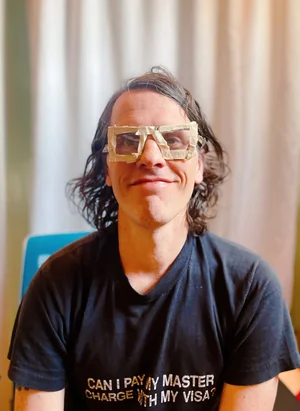
Episode 49: Derek Howard
Derek Howard: So I'm just spiraling. It's one of those nights where I'm just totally awake, eyes just open, just thinking, thinking, thinking, thinking about all the possibilities. When we go to the desert trek, I'm not gonna be the only one. There'll be a group of us and I'll be safe in the numbers. And so I kind of felt, you know, naively, I'm like, I'll be okay if things go bad.
Josh Caldwell: Hello, my atypical daydreamers. Welcome to the podcast. This is a show about life on the road. My guest today is Derek Howard. He's a cinematographer, a filmmaker, and a seasoned world traveler. I love a good road story that blends innocence and beauty with the real messy existential threat. One of those no-turning-back journeys where the only way out is through. Today, Derek takes us deep into northern Africa with just that kind of story. And a quick heads up: this episode includes content that may be triggering for those who've experienced assault. Please listen with care.
Derek Howard: In the summer of 2006, I had this idea of going on a solo one-month-long trip all through Morocco filming my thesis film. I was in film school in Vancouver at Simon Fraser University, and my thesis film was gonna be shot on Super 8. I was gonna shoot it by myself in the Sahara Desert, and I didn't really have a strong plan. It was kind of a loose road trip narrative, very experimental. So I left my friends in Spain. We were in Cadiz and I took a bus down to Tarifa, spent a few nights, then took the ferry from Tarifa over to Tangiers. I'm on the ferry, I'm going across, by myself. I've been with my friends for the last two months. I'm maybe 23 years old. I get off the boat. I'd never been to Africa before. And then I'm immediately descended upon by local guides who want to help you out, show you around, extort money out of you.
I say no, no, no. I have my hotel booked. I'm walking. The entire time I walk from the ferry terminal to my hotel, there's a group of four or five guides vying for my attention, trying to get me to tip them out and take them on as a guide. I finally get to my hotel and go to bed. I get up hours later and come out and sure enough, several of those guides are still waiting for me outside. They literally lead me to an ATM machine and tell me to take money out and give it to them. Otherwise they're not gonna leave me alone. I'm only giving them the equivalent of maybe ten bucks, but it was this moment of like, okay, now I'm a walking dollar sign and I need to take care of this.
So I have lots of adventures in Tangiers and end up at this rooftop cafe with a lookout over the harbor. And this guy sits down beside me and we're enjoying some Berber whiskey, which is just mint tea. We're just chatting, and he's like, hey, do you want to meet a famous artist? I'm like, of course I'd love to meet a famous artist. We jump in a taxi and he starts leading me on this wild ride through Tangiers, and we eventually arrive at this little apartment. We go upstairs. Very mysterious.
Derek Howard: I get in there and there's this elderly Moroccan man cooking a fish tagine. The house smells amazing. And this guy I met at the bar introduces me. He's like, this is Mohammed Mabret. I don't recognize the name. But I start to notice on the walls of his apartment, completely plastered from floor to ceiling, are photos of this guy with famous American beat poets. He's with Ginsberg, he's with Tennessee Williams, he's with Paul Bowles, he's with Jane Bowles, he's with Truman Capote. These beat poet generation people were obviously very close with this guy. So we have a conversation over dinner, and it becomes clear that this was actually Paul Bowles's lover and chef. He's like, you want to buy one of my paintings? They're beautiful. He says, it's for you, I'll give you a really special price. Two hundred euros. And I'm like, I'm backpacking by myself and two hundred euros is my budget for several days. And I can't take this art with me, it'll get destroyed. So I say, I'm so sorry, I can't buy that. But he's written a number of books and translated all of Paul Bowles's books, and he's also written his own novels. So I buy one called Love with a Few Hairs, and he draws a little picture in there and signs it. It's really sweet.
Just before I leave, he tells me, since I'm there to shoot a film, whatever I do, shoot the film in Erg Chebbi. I'm like, what's Erg Chebbi? He's like, that's the sub-Saharan desert. That's the area where the sand dunes meet the civilization. And I'd already set off to make my film in the Sahara Desert. So I'm like, okay.
Derek Howard: The book's great and I later adapted it into a screenplay. I don't believe in coincidences like that so I thought it meant something. I'm on trains and buses heading down through Morocco. I decide I need to go shoot my film now. I meet a guide and he says, yeah, I can take you to Erg Chebbi, the sub-Saharan desert, on a three-day tour, all inclusive with food and transportation. It'll all be taken care of. I'd done some due diligence, checked this guy out, it sounded pretty legit. So I'm like, okay, let's go.
I give him the money. So it starts on this bus. And even though I've already paid this guy the lump sum to cover everything, he's still asking me for the bus fare every time we go somewhere. That's the first red flag. But because everything's so cheap in Morocco, I don't really worry about it. We travel for a while on typical buses, packed, sweltering hot. We stop at another place for hours waiting for another bus. There's no schedule, you're just waiting. Morocco is a very diverse landscape. You can go from a sub-Saharan desert climate to a mountain climate to a desert and ocean climate all within a few hours. We're looking out the window, it's just gorgeous.
We happen to be at high altitude in the Atlas Mountains, heading towards Marrakesh, and the bus breaks down.
Derek Howard: It's about a hundred and ten, maybe a hundred and fifteen degrees outside, no shade. And everyone just starts getting off the bus. Out of nowhere, all these taxis start appearing. Everyone from the bus just starts getting in these taxis. And I don't know anyone except my guide. Everyone on the bus just starts to disappear. The bus is smoking, the hood's up. More than half the people have now just disappeared into random taxis. Me and my guide are just sitting there like, well, how are we getting out of this?
Eventually everyone disappears. We're the last ones. Hours go by, the bus is not fixed. Finally he hails a taxi. Six of us random people from the bus pile in. We're off to our destination, Erfoud, many many hours away. It's a night trip now. Days have turned to night. I'm in the middle of this cab, just flanked by all these people. Seven of us in a car built for five, bouncing along. I have no idea where we're going. We haven't had food or water in a long, long time. Our lungs are full of dust. It turns out to be a seven-hour taxi ride. We pull into our destination just as the sun's coming up, totally wasted from exhaustion.
His parents live in this town. We're gonna use this as our base and make it to the desert in the next couple days. We go to his parents' house. I have a shower with a bucket of water over a hole. His name is Hisham. For him it almost feels like I've just financed a trip home, where he's meeting all his friends, making me buy hash and smoking it with everyone, just having a trip down memory lane. He said it was all inclusive, but that meant like a piece of stale bread with cream cheese smeared on it. That was dinner one night. He was really just interested in smoking as much hashish as possible and reminiscing with old friends.
Derek Howard: So we literally spent the whole day with him taking me around to different friends who were inevitably hash dealers. Nightfalls, we're exhausted again. We go back to his parents' apartment. He's like, okay, tomorrow we go to the desert. We need a good sleep. And before bed, he's like, time to give you the traditional Berber massage. I'm like, okay, I know people in Morocco, their comfort levels in terms of physical proximity are a lot different. So I take my clothes off, I've got my underwear, I go into my sleeping bag on the couch. He starts to rub my shoulders and chest. I'm starting to feel uncomfortable because I can tell he wanted a bit more than a massage. I push him away. I'm like, no, no, like I'm good. I don't want that. He goes back to his bed.
It's quiet for maybe five minutes. And then he's back on top of me. He's like, it's traditional here that we do four kisses goodnight. You have to kiss me four times. I'm not sure I've heard of that custom before. But I'm in this person's home, I'm young and naive, and I'm thinking, okay, this is what you do. So we kiss four times and it was okay. But then the last kiss, you could tell this was not consensual. He was pushing me down and holding me down. So I pushed him off. I was pretty flustered because I've never had anyone force themselves on me like that before. And furthermore, this is my guide, someone in a position of power. I need him. I depend on him. I can't just leave because I don't know where to go. I don't speak the language. So I didn't feel like I could react the way I would have if I wasn't sequestered in this far off place.
I push him off and think it's over. And then maybe five, ten minutes later he's back and really went for it and it was really intense. And I remember pushing him off quite violently and being really shaken up. He could tell I was shaken up because I think I was shaking. So he finally got the message and stopped.
Derek Howard: But the whole night was a sleepless night. He went to bed and I'm just lying there paralyzed. I'm thinking, the next day I'm going to the Sahara Desert with this person who just forced himself on me. My head starts to spiral. I know he carries a knife. What if the knife comes out when we're in the middle of the desert? So I'm just spiraling. It's one of those nights where I'm totally awake, eyes just open, thinking about all the possibilities and how I'm gonna get out of this mess. But I've already paid him all this money and we're already all the way out there. And surely there'll be other people around. I'm thinking, when we go to the desert trek, I'm not gonna be the only one. There'll be a group of us and I'll be safe in the numbers. I am bigger and stronger than him, so I kind of felt naively like, I'll be okay if things go bad.
Josh Caldwell: Hey, it's Josh. Hope you're enjoying the podcast. And if so, are you wanting more road stories? Well, good news. I've got you covered. Consider becoming a patron. You'll have access to loads of great bonus stories that there just wasn't time for. And you'll be supporting a truly independent podcast. Find the link in the show notes and thanks. Now back to the show.
Derek Howard: Next day comes. We take a taxi to the edge of the town, Erg Chebbi, we get the camels. Everything's cool, but the place is utterly deserted. This little village on the edge of the sub-Sahara pretty much exists just to service tourists. There's no real city, just a place to buy warm Coca-Cola and figs. Pretty sparse on supplies. I'm wondering the whole time where is this food gonna come from?
I'm on the camel and I thought he'd be on a camel too, but he's just walking in front, pulling the rope. The optics of that I didn't like. Furthermore, I figured we'd be moving at the pace of an animal walking, not a human pulling an animal. The whole thing was slower and less of a trek, more just a guided walk. And then I realized there's no one else with us. Literally no one. Now I'm being led into the desert with a person that assaulted me twelve hours before. No one in sight. But I didn't feel like I could change course. He was the only person who spoke English. I didn't even feel confident I could get out of that town by myself, let alone the desert. So I was like, you know what, I'm just gonna have to play this out. I've gotta hope that last night was a stupid one-off mistake.
I distinctly remember the feeling of going from the road to stepping off into the sand. The camel's feet go from road to sinking down into sand like quicksand. And I remember this sinking feeling as we left the road and were only on sand. I'm like, I'm going down. But at the same time, it's the most jaw-droppingly beautiful setting you've ever been to. There's this weird thing inside of you where your sixth sense is on and you're dreading something, but at the same time you're surrounded by such beauty that you're also just gobsmacked. And as a filmmaker, I'm such a visual person, I got my camera out and I'm filming the sunset, filming all the footprints and the sand swirling on the dunes. We're stopping at the top of dunes watching the sunset. Some of the most beautiful sights I've ever seen in my life.
Derek Howard: In a way, the beauty of the day kind of erased the trauma of the night. And we get to the oasis where we're gonna camp. And thank God there are like two or three other guides with two or three other people. I'm safe. It's okay. There's other people here. Someone from Canada, someone from Montreal. I really started to feel a lot more comfortable. And then they go to a hole in the ground, a hatch, and they pull a rope up from a well, not with water but with food that had been cold stored. All the preparation you'd need to make a really nice chicken tagine. They fire up the grill, they make this incredible tagine, the food's amazing. The Berber tea is flowing, the hash is flowing, we're having a campfire. Wow, it's all that I hoped it would be. This is great.
I'm getting to know the other people, we're looking at the beautiful stars. You can see a million shooting stars. Just stunning. And then we all go to bed in separate tents. But then my guide comes into my tent in the middle of the night. And he has the knife. And he's basically saying if we don't do what he wants to do, he's gonna hurt me with the knife.
Derek Howard: I'm in shock because I thought we were past this. And I'm also in shock because the other tents are maybe fifteen feet away from me. If I were to make any sort of yells or screams, I think it would be heard. So as he's coming at me with the knife, I tell him, this is not happening. There are people all around me and I'm gonna scream if you take one more step closer to me. He lunges at me and I grab the knife. I'm lucky enough that he is a fair bit smaller than me and I was just stronger. He bolts out of the tent.
I was terrified because I've never had a situation like that with a weapon involved. But I don't feel safe leaving. I just stay in the tent with the knife and go to bed. Next morning I get up, everyone's gone. Including my guide. Everyone's gone. The camel's there. My camel is there. But everyone else is gone.
I'm obviously in shock. I've been abandoned in the Sahara Desert. I have no idea which way out is. I don't have water. I was relying on my guide entirely for all the provisions. There is one local person who was already at the oasis when we came. He lives in the area and doesn't speak any English at all. I go over to him and through a series of pointing and a guidebook with words, I piece together that my guide left with the Canadian family. He basically ditched me. Probably because I wasn't a proper victim for him, or since he didn't get what he wanted from me, he just ditched me completely. And he took my money. I was supposed to have room and board all the way back, a five-day trip, and he completely blew that off.
So I have no choice but to convince this guy who lives at the oasis to take me back to Erg Chebbi because I need to get back to civilization. It takes a long time to convince him to go, but I think he realized that if he wasn't going to take me out, I would probably not make it. So he takes the rope of the camel and we both just walk out. I'm not gonna ride this time. We're just both walking. The entire three or four hours of trekking, all he says is floosh, floosh, floosh, which is Arabic for money. He's just like, give me cash, give me cash, give me cash the entire way.
Derek Howard: I don't have any cash. My guide took it all. I had my cards, but there's no ATMs around. We get to the small village and there are no ATMs. So he insists we take a taxi to the nearest ATM. Of course, I don't even have money for a taxi. So he gets his friend to take us in his car. We drive another hour to the nearest ATM. And of course the first two cards don't work at all. I'm starting to freak out. The guy is not going to take no for an answer. The third card, after calling my bank, finally works. I get a couple hundred dollars out and give the guy whatever it was, and he lets me go. From there I was able to take a train back to Marrakesh and continue my trip.
So I did make it out of the situation in one piece. He didn't get me with the knife. He didn't actually sexually assault me that second time. I kind of consider myself pretty lucky for how I came out of that situation. And I got amazing footage too. Now to this day, when I watch that footage, it brings back this amazing mixture of terrible trauma mixed with a feeling of beauty of the earth. Almost like my love for nature helped me survive that in a way. I somehow felt that my love of natural landscapes and the beauty out there kind of gave me strength to persevere through that.
And the weirdest thing is I get back and finish reading Love with a Few Hairs, and I look up Mohammed Mabret, and apparently he was a huge famous artist. He had solo shows at the moment and the piece he was trying to sell me was worth like fifty thousand dollars. So I really should have bought that piece.
Josh Caldwell: I want to thank Derek for sharing his experience. Be sure to check out his most recent project, a horror film he shot called Eugene the Marine. And the upcoming documentary called Totally about last year's solar eclipse, due out in 2026. This podcast is created and produced by me, Josh Caldwell. Music by Visual Aid, my side music project. General support and copywriting by Miranda Caldwell. Thank you for listening, and I hope you come back next time.