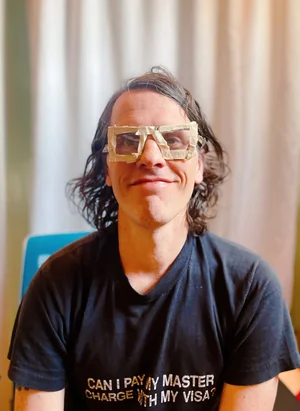
Episode 47: Robert Bell
Robert Bell: It sounded like some sort of terrible threatening thing, like a roar or something. And I thought that it was another attack of some sort. I got so freaked out.
Josh Caldwell: Hello, my atypical daydreamers. Welcome to the podcast. My guest today is my old pal Robert Bell, or as I call him Bob. He is a former New Yorker. Since I knew September 11th was coming up soon, I thought about him. Bob was living in New York City on that wild morning. September 11th, 2001 was 24 years ago. And for myself, these days it feels more abstract, more like a symbolic day of remembrance. Similar to how I think about the attack on Pearl Harbor. So I decided to revisit that day and share my version of the story, once removed. At that time, I was working the night shift at a mastering studio in Hollywood.
Robert Bell: I would usually get home and stay up till dawn. That morning, I watched Werner Herzog's film Aguirre, the Wrath of God. It's a film about a doomed Spanish expedition drifting down the Amazon River in search of El Dorado. The final shot shows the last-standing conquistador, Aguirre, alone on a broken wooden raft, surrounded by dead bodies and a swarm of tiny monkeys. He's delusional, still obsessed with conquest, drifting toward certain death. So as I was getting ready for bed, my phone rang. It was my friend Dave in Atlanta. Basically he said, turn on the TV, they've hit the World Trade Center. There's possibly a plane headed for LA. Then came another call, a New York number. I picked up, it was Bob.
I honestly don't remember the conversation, but I remember his voice shaky and him saying, everything's changed. Everything's changed. In today's episode, Bob takes us back to that morning, shares his perspective, and finishes with a bit of unexpected sweetness that unfolded a few years later.
Robert Bell: I had really bad anxiety living in New York, was racked with panic attacks for years. And at this point I was managing that through pot. So I smoked every night. That particular morning I was late to work because I'd just dozed through the alarm. It was after nine by the time I left my apartment in Washington Heights and took the train downtown. What I remember is a couple of things. It was a really lovely morning. It was like that first morning of fall, really crisp and clear. A front had come through. I was reading the book Desperate Characters by Paula Fox, which always stands out in my memory because it's such a New York book and I love it.
The ride was really long and we were going to stations I didn't recognize. Trains get rerouted, it happens. But it was a strange route and the station I got off at was not the one I normally got off at. I noticed there was a really long line to the PATH train to New Jersey. Almost ten AM and that's weird. But I have this sort of marshmallowy pot haze that I'm living in. So it all just sort of rolls off me as strange, but it doesn't add up to much. And then I step out on Sixth Avenue. I'm on the shaded side of the street. I can't see very much. I grab a coffee at the bodega and I step out and I look across Sixth Avenue and I see this crowd gathering and looking up at the sky in the sunlight.
And so I cross and that's when I saw both towers were smoking. You could see very clearly down Sixth Avenue, the two towers, both of them burning. And that's just something you can't really wrap your head around. What is this?
Robert Bell: My office is right there almost at the corner. I walk in, we have a door guy, and I start talking to them. They tell me it's an attack. At that point, everything's really blown out of proportion, exaggerated. This is 2001, before social media, and yet somehow there's this rumor mill that gets cranked up right away. Some of what they told me was accurate, like that the Pentagon had been hit. But some of it was like the White House had been hit. And so I got in the elevator. I didn't think of terrorism. Not on that scale. As I understood terrorism from watching the news growing up, it was like bombings in London. It wasn't actually flying planes into buildings. That was not something I would have thought of. I thought it was like a war, an attack from I don't know, North Korea or something.
I just didn't know that we would all make it through the day. To be honest with you, once that thought was in my mind, I was like, well, I live in New York City, we're already being attacked, I don't know what this day is gonna bring. That was the first time I think in my life I'd ever contemplated something like that. And then I stepped out of the elevator and went to my office. This woman I worked with, a partner agent, had lived in Lebanon growing up in the 80s. She was incredibly distressed, she'd been crying. It was hitting someplace in her that she could recognize. And the thing about this office was that we'd moved in maybe just a couple of weeks before.
Robert Bell: A crazy coincidence. It was on the twenty-third floor and you could just see all of downtown on the clearest day. So it was a perch to watch what was going on. And other people from offices on that floor that didn't have the same view, they came in and they joined us. That was an interesting study in humanity because as people came in, they all had different reactions. Some people joked about it, it was their way of coping. I was trying to call out to people I knew. I had a girlfriend who worked on 14th Street, a little closer. It was difficult to get a line out.
I think I reached you around that time and you've told me what I said, but I honestly don't remember saying it. The thing of everything has changed, I recall the crowd in the office was having that conversation. Like, we're in a different world now. So I might have just been repeating that. It might have been all I could really think to say. I reached my girlfriend, and that's when the first tower fell. I saw that clearly from the window. I was like, okay, I'm gonna go. And then shortly after that, the second tower fell.
We weren't in the financial district. We weren't directly impacted in any way that so many people were. We were close to the Empire State Building though. There was always the worry that if they've hit the World Trade Center, they're gonna hit the Empire State Building. So we gotta get out of here. That was true not just that day, but in days to come. There would be threats against the Empire State Building and we'd have to evacuate.
Robert Bell: So I ended up leaving the office, walking downtown to meet up with my girlfriend and one of her friends. That friend had an apartment on 70th Street. The trains weren't running. There was no way to get out of there except to just try to get uptown. If there were going to be any more attacks, we thought they'd be downtown. So just get up to the upper east side where the friend lived. We spent hours walking up to 72nd Street. I remember just thinking, the world had changed, but maybe my life had changed too. I didn't know also how I would emerge differently from all of this. What is this going to mean for me and for the life that I'm living here?
It was a pretty uneventful walk except it was just a long walk on a very nice day. Aside from the attack, it would have been a lovely day to take a long stroll. There was a sense, as there often is after a tragedy, of coming together. People were really nice to each other. A fellow feeling you could sense. I also remember some anger. Maybe what we had done to make that happen. Some people were ranting about that on the trains. And a ton of paranoia. The whole anthrax scare happened shortly after. A definite threat you felt.
I also remember the office was on the same street as one of the major firehouses. The firehouse where I think his name was Father Michael Judge was from. He was killed that day. That's a story that's been often told, that he took off his helmet to pray and was hit over the head with debris and killed. I remember going to his wake. It was open to everybody. I remember seeing his body in the casket. I remember looking around and seeing all the firefighters who'd been down at the World Trade Center and survived it. Just how beaten up they were. All black and blue. Just sitting there stunned.
I think sometimes I have a hard time these days when tragic things happen. Like with the floods here in Texas, it's hard for me to engage with it and I feel bad about that sometimes. I work around a lot of people who are out there helping and donating and talking about it and I think that's wonderful. And I feel almost a sense of guilt that I just shut down. And I think it's because of this experience. I felt so much in the middle of it. And I remember walking for weeks past the walls of pictures of people whose families were looking for them. It was just heartbreaking.
I remember one particular moment, in Washington Heights there's a museum called the Cloisters. It's very quiet and above the city. The highest natural point in Manhattan. I'd go up to that park, get stoned, walk up there, just sit by myself and try to get away and find some peace. And I remember one time I heard a ship coming down the Hudson blowing its horn. But it sounded like some sort of terrible threatening thing, like a roar or something. And I thought it was another attack of some sort. I got so freaked out. I think I literally ran away from the bench, worrying that there was some other threat coming down.
Josh Caldwell: Hey, it's Josh. Hope you're enjoying the podcast. And if so, are you wanting more road stories? Well, good news. I've got you covered. Consider becoming a patron. You'll have access to loads of great bonus stories that there just wasn't time for. And you'll be supporting a truly independent podcast. Find the link in the show notes and thanks. Now back to the show.
Robert Bell: I was studying at City University of New York, finishing up my master's in education. It was, I think, the hottest day of the summer, at least in my memory. I was with some folks I was going to school with who were also teachers. We were heading back home from summer classes. And as we were heading back on the train, the train stopped at a station. The doors were open when all the lights went out. And if they hadn't been open, if we had been in the middle of a tunnel, it would have been a totally different story. But I was able to just walk out of the train. I don't remember any thought of nine eleven.
Which is a good thing. I think that was an interesting thing about nine eleven, is that New York, in my experience, experienced it obviously firsthand and acutely for a good period of time. A few years later when the blackout happened, I think New York had probably moved on more than the rest of the country had from nine eleven. And so it didn't come to mind. It was just like, the power's out, you know.
I think I parted ways with whoever I knew that was riding with me because they were going off to their neighborhood and I needed to walk back to mine. So I just started trekking through Brooklyn, middle of the day, very hot day. I remember there was an Italian ice place along the way and they didn't have refrigeration, so they were just giving away Italian ices. People were lined up grabbing Italian ice. And I remember seeing a couple of guys who looked to be like Wall Street guys. They had unbuttoned their shirts and their big bellies were hanging out and they were just walking down the street with Italian ices and everything.
Robert Bell: There was a sort of carnival atmosphere that emerged pretty quickly. I got a sense like, this is 1977. Like the hipster kids and whoever lives in Brooklyn now getting a day off. There were all sorts of people out on the street. Some people hustling and price gouging as much as they could. But it was fun. People just started striking up conversations in the street. There was almost like an era of romance. I saw some coupling happening as I was walking along.
I just went back to my place. Night fell. I had the windows open because it was still a hot day and there was no air conditioning and you could just hear everybody out. And I think I did go up to the roof of our apartment and there were people up there and there were people up on other roofs. And it was nice. I like moments of transformation. That's why I like snowfall. Snowfall always transforms a city. You're in one city and then the snow falls and for an hour or two you're in a whole different city. And you haven't really gone anywhere, but everything's just changed around you in a delightful way, not in a scary way. And that's kind of what this was. Everything changed around us in a very festive way. It was like a big block party that got to happen that no one expected.
Josh Caldwell: I want to thank Bob for sharing his experience. Be sure to tune in in two weeks for the next episode where musician and wild man John Wesley Coleman shares a classic shit has hit the fan tour story. This podcast is created and produced by me, Josh Caldwell. Music by Visual Aid, my side music project. General support and copywriting by Miranda Caldwell. And if you know someone who you think might enjoy this show, send them this episode. The support really helps. Thank you for listening, and I hope you come back next time.