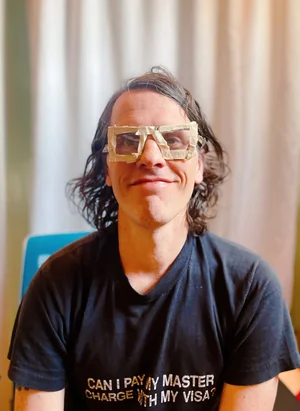
Episode 25: Manny Nieto
Manny Nieto: So they took me down to the police station. I was there for two years and this is a year in. And I'm like, I'm fucked. There's no way I'm going to get out of this. I'm going to take all my gear. And at that point, I got to figure out a way of getting back home to the States.
Josh Caldwell: Hello my atypical daydreamers, welcome to the show. My guest today is Manny Nieto. He's a studio owner, record producer, and microphone wizard. But he's also an explorer, tracker, archivist. Not only did Manny buy a one-way ticket to China, he spent two plus years traveling through Asia recording punk bands, all while trying to avoid deportation.
Manny Nieto: I used to buy and sell vintage gear for a living. Before it became cool, I literally would drive all the way up the coast to buy vintage and rare guitar pedals, and that's how I made a living. In late 90s, I started building recording studios and making my own records. Somewhere around 2011, after I've already made thousands of records, I decided to leave the country. I just got fed up with LA, a little jaded, not really happy. I wanted to know what it was like.
Because living in LA, you're in the Mecca. You get all the best bands, all the best music, the best food. It's a cultural center, a melting pot of different cultures. So being in LA, I was getting the best of the best, but I felt like people that were the best were not appreciative of that. Part of my journey was living in a hotel in Honolulu for like two years, recording all the punk bands on the island. So that was exotic and crazy. I got a taste of what it's like to fly somewhere and not know anyone and just start recording all the local musicians.
So when my friend told me that he had heard about some bands in China, I was really fascinated because social media at the time, we're talking like 15 years ago, didn't permit me to see what was going on there. I'd have to find an email or find a blogger or someone had to tell me, yeah, there's some great bands in Beijing. So as I researched China, I found out there was a main center for punk and avant-garde bands in Beijing. Then I found out there were some punk bands in Shanghai, Hong Kong, and Chengdu.
In my studio at the time, there was this microphone that said, made in China. But at the time, the wave of manufacturing hadn't yet taken over the world where China was the epicenter of getting things. So I got this microphone, called the company, it was somewhere in Europe, and I said, listen, I want to go to China. Does this microphone company have a factory there that I could possibly fly to, pick up all the microphones, and record Chinese bands?
Manny Nieto: They put me in contact with a guy named Sui and I said, listen, I'm gonna buy a one-way ticket into Shanghai and then I wanna travel from Shanghai to Beijing to Hong Kong to Chengdu and travel around China and record bands. Would you be able to donate microphones for that? And then I come to find out I wouldn't be able to travel around China unless they gave me a document that permitted me to say I was going to a factory to get some merchandise and then I could travel around testing the merchandise because musicians were looked down upon. I couldn't say I was an artist going over there to record artists, because they would just kick me out of the country. So Sui agreed to give me a letter that would permit me to travel to China.
Then I went down to the Chinese embassy and when I went to get my visa, the lady told me that if I went into China, I wouldn't be able to leave. And if I did leave, I would never get back in because my visa wouldn't permit it. But she knew someone at the embassy and if I would pay, I think it was like $500, she would give me a visa for two years with endless in and outs of China. So I was smart enough to get that visa.
I flew into Taipei and then when I was flying into China, their government took almost all my recording gear. I'm already feeling like this is fucked. I finally flew into Shanghai, kind of half loaded up, lost a lot of my gear, but I knew I'd get microphones from SE. So when I landed in Shanghai, a limo picked me up and drove me out somewhere into the wilderness to what looked like a Russian tank factory. They had all the machinery in there, probably Russian and Chinese, and they were building their microphones. Sui was really nice. He let me just pick all the microphones I wanted that could fit in my backpack. And then after that, I traveled around China for close to two years.
I lived off and on in Beijing for about six months. I lived off and on in Hong Kong for about four months. And then I lived off and on in Singapore for two years, flying back and forth to Hong Kong and Shanghai and Chengdu. I would fly to Chengdu and record a band that had this house on a lotus pond, or I'd go to Beijing and record bands in Cold War bunkers underneath the city. There's no way to know where they are except you'd have to go into these apartment structures and there'd be these doors with tank marks going down into the earth and I'd follow them down and all the musicians lived in the bottom of the city. But they're all under the conditions that if there was a war or if some generals were flying in from Beijing, they would have to clear out the bunkers and the musicians would have to leave.
Manny Nieto: You could see China was becoming like the US. When I went to China and landed in 2011, I would in Chengdu, there was a Rastafarian bar and they're all Chinese, but they would bring in bags of weed because marijuana would grow just freely out in the wilderness and they'd bring in the bags and smoke it. The cops would come in and they wouldn't know what it was, they'd just think they were smoking a weird incense or something. And then later on there was a crackdown on marijuana and drugs. And when I first went to Shanghai, the police were not really doing anything. And towards my end in 2013, I would see all these Mercedes Benz and rich cars getting pulled over and people getting drunk tests. Society started to realize as their middle income started to come up, they would then capitalize on all the things that we have in our culture, which is making money off of the people that are making money. So China was definitely changing as I was there.
So through my adventures, about a year into my trip, I'd flown into Hong Kong, which is technically leaving the country, but in all realistic views I'm not leaving China. It was just a procedure. I had to travel from Hong Kong into Shenzhen. Shenzhen is the next city next to Hong Kong. The reason was if I flew out of Hong Kong, being an international airport, a flight to Chengdu could be three or $400. But if I crossed the border from Hong Kong into Shenzhen, it's only $50 to fly from Shenzhen to Chengdu.
So as I was crossing the border a year into my trip, the police pulled me over and pulled me aside because when they x-rayed my bags, they were full of microphones and stuff. And there was a lady cop and she was really upset at me. She was pointing at everything in my box, the mics, the cables. I'm assuming she's saying this guy's an artist, his paperwork, I don't know what he's doing. So they took me down to the police station. I'm thinking my trip's over. I was there for two years and this is a year in. I'm fucked. There's no way I'm gonna get out of this. They're gonna take all my gear and I gotta figure out a way of getting back home to the States.
Manny Nieto: So they took me to the police station and the lady's really upset at me and she calls the chief, who comes in. He's a really mean looking guy and he looks at me and he goes, where are you from? I said, I'm from United States. He goes, where do you live in the United States? I live in Los Angeles. He's like, where's Los Angeles? I go, it's in California. He goes, oh, California. Okay. And he goes, what do you do? And I said, at that point I think my game's over. So I'm like, oh, I'm an artist, I'm a musician and I'm traveling with all these microphones to test the microphones with Chinese bands. The lady interrupts and starts telling him a bunch of stuff in Chinese. And at this point, I've already been there a year, I don't understand anything they're saying.
And he looks at me and he goes, so you're from California, huh? And he goes, sing Hotel California. And I was like, what? And I'm like, on a dark desert highway, cool wind in my hair, warm smell of colitas rising up through the air. And I sing the whole song and he just starts smiling. The other cops look around and he goes, he's from California. He's singing Hotel California, let him go on through. And she was so mad. The cops drove me back to the airport and they permitted me to get on my plane. And I flew out to Chengdu by singing Hotel California to a bunch of Chinese cops.
Josh Caldwell: Hey, Josh here. I love making this podcast and I'd love to make it my full-time gig. Besides telling the stories, I'm basically a one-man band and that takes time. If you're enjoying the podcast, please consider becoming a patron. You'll have access to loads of great bonus stories and you'll have the satisfaction of knowing that you're supporting a truly independent podcast. Find the Patreon link in the show notes. And thanks.
Manny Nieto: One of my favorite breakfasts in China was every morning I'd walk out and there'd be a lady with a cart and she had this round grill and she would pour like a crepe batter on it. And then on top of the crepe batter, she would put two eggs or one egg on top. And then with a bamboo spatula, break up the egg, spread the egg in a circle over the circle of crepe. Then she would flip it over. So now you're looking at the top of a crepe with the egg cooking on the bottom. And then they would put this black almost like a Chinese bean paste, and a chili paste, onions and cilantro, and put a square wonton on top. Fold it around it. It almost looked like a sandwich of a cube of bread because the wontons were square. And then she would crack it in half and give it to you. So when you bit into it, my God, it's called Jian Bing.
I found it in Los Angeles. There's a Chinese epicenter down on Garvey and Monterey Park in Los Angeles. And I found a place that made Jian Bing there, but it didn't taste like the Jian Bing that I got on the street. So a comparison would be someone telling you that you think Taco Bell is good tacos, why don't you get some street tacos? Those are the real tacos. Jian Bing is the equivalent of that.
When I would get the street food, because they didn't know how to really get around, I would have to tell the taxi where my hotel was in Chengdu to where I recorded. It was a two taxi stop. I would get on a taxi where the studio was and I would say me to, and I had the name of the Rastafarian Bar. They would know how to get me to the Rastafarian Bar because the taxi guys don't have addresses. You have to tell them, take me to the third bridge near the fourth university, and then they would drop you off at this iconic symbol of a building or a school or a bridge.
Manny Nieto: And then because there were mystery meats and not knowing what the meats were, I would always get the skewers with broccoli that tasted like steak. It was amazing. So whenever I arrived off my taxi, I would go get my steak broccoli. And then I would go into the Rastafarian bar, have drinks of, I don't know if I was really drinking tequila, but it said a tequila label. And that was another thing. You didn't know if you were drinking tequila or even cigarettes. Everything was just bootlegged over there.
And I remember when I had first landed in Taipei, there was a band I was working with. I really loved them. They're called My Skin on Your Skin. And I remember when I first landed in China, they had taken me down to this local food area. And I saw these guys dipping like chicken into like, it looks like some sweet and sour sauce. I was starving and I'm like, can we get that? And they're like, no, I don't want to get that. I was like, why? And the girl's like, well, because that's dog's blood. I was like, my God, what? And they said, yeah, it's not legal, it's not on the street officially. But if you're from Taipei and you want to get your favorite chicken with its favorite sauce, it was like this dog's blood, sweet and sour dog's blood, something like that.
So there was always mystery food around. But there was another place in China where a band took me and there's a numbing oil, which I'm not even lying, it's like cocaine, because it numbs your mouth like you just got a bunch of shots from the dentist. And they would put it on their fish. So if you got this hot fish, some of your mouth and your throat and your face would start numbing. I was like, what is going on here?
And also you had to be careful too with the mystery stuff. I remember when I was in Beijing, there were all these restaurants and they had horses and donkeys outside. You'd go now and you see a chicken and there's a circle and it says Kentucky Fried Chicken. Well, they would have, I don't know what it said in Chinese, but they'd have a donkey's head. So I was with a band and they had these that look like tortas, which is a version of a Mexican sandwich. And as I was sitting with the band to eat, I was like, what does that mean? They're like, oh, it's donkey. Or you'd go to McDonald's and their sign would have a coffee and a hot dog. And they'd be like, hey, breakfast for our champions. I was like, what? You're eating a hot dog right now?
Manny Nieto: But my point was, there's no way I'm gonna have a hot dog in China with a cup of coffee and be like, hey, let's start the day.
Josh Caldwell: I want to thank Manny for sharing his experience. Be sure to check out his Instagram and YouTube channel. Find both at Manny's Mike Locker. This podcast was created and produced by me, Josh Caldwell. Music by Visual Aid, my side music project. General support and copywriting by Miranda Caldwell. If you like the show, please follow, subscribe, rate, and review wherever you listen to podcasts. And if you'd like to financially support the show, check out my Patreon page. You'll have access to loads of great bonus stories. You can find the link in the show notes. Thank you for listening, and I hope you come back next week.