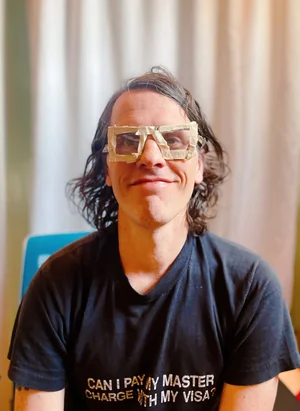
Episode 16: Stephen Flinn
Stephen Flinn: And I was in a really good mood. I thought, man, I'm going to make some serious bread tonight. It's Halloween in San Francisco. And I'm walking back to my cab and at the corner of my eye, I see him charging me like a bull with bad intention.
Josh Caldwell: Welcome to Atypical Daydream, a podcast about life on the road. I'm Josh, your host, and thanks for stopping by. My guest today is Stephen Flinn. He's a composer, drummer, percussionist, and teacher. Many of us live anchored and steady lives, not choosing to wander too far. Stephen seems to have taken another path with many bends in the river, some wild, some searching, but all with spirit.
Stephen Flinn: I had been on the road and I had moved from Los Angeles to San Francisco. And I thought, well, I'm gonna go straight. I'm gonna try and get a day job. And I was applying to these tech companies and such. And because they were tech companies, I gather they were Googling me and they wouldn't even give me an interview. So I thought, okay, I've got to get a hustle going. So I decided to drive cab in San Francisco and I drove cab for eight months at night and a few nights a week.
Every year in San Francisco, there's what's called the Folsom Street Fair. It's a fair that celebrates the S lifestyle in San Francisco because the Folsom Street area, south of Market, is where all the S bars used to be. It used to be a really wild event. And I was driving cab that afternoon and I remember I was driving down from Diamond Heights and I picked up these two gay gents that were on their way down to the Folsom Street Fair. And one of them was this big guy, man. He looked like he could have been a linebacker for the Packers and he had the leather shorts on and the strap and everything. And his partner had on a dog collar and chain, a leash rather. And he pulls him into the cab and they're all leathered up.
So I'm talking to him. I lived in San Francisco for the majority of my adult life so none of this really fazes me. But I look back and I'm looking at the slave and the guy's not talking and he doesn't look right. I go, what's up with your friend? And he goes, well, he's my slave. And I go, yeah, but what's going on? He goes, well, I decided he was talking too much. So I had his mouth sewn shut. So this guy had a fully stitched up mouth. I guess he got his nutrition through a straw of some sort. I was really taken back by that and I took them down to the fair and they went on their merry way.
Stephen Flinn: It was Halloween and I was in a really good mood. I thought, man, I'm gonna make some serious bread tonight. It's Halloween in San Francisco. If you've never been in San Francisco on Halloween, it's pretty crazy. Everybody goes out. I went down Sutter Street and at Sutter and Polk there was this place that had great turkey burgers. So I pulled my cab up, got a parking place right in front, jumped out of my cab and this guy goes, you got five bucks? I'm like, dude, I just started my shift. Why are you hustling me? I'm a cab driver. I didn't even acknowledge him. I went and ate my meal and I'm walking back to my cab and at the corner of my eye, I see him charging me like a bull with bad intentions.
I jumped in the cab, hit the lock, and he jumped up on the hood of the cab and his face is right on the glass in front of me. He's got this wild look in his eye like he's on amphetamines or something, eyes wide open, holding onto the cab really tight. I'm like, dude, get the fuck off my cab. And he doesn't move. He seems even more intense. I'm kind of afraid because I'm like, does this guy have a gun? Does he have a brick? I tell him again, get the fuck off my cab. He doesn't do it. And I say, okay, I'm gonna leave. And I just started to slowly back up the cab, he didn't get off, and I gunned it as hard as I could and turned the wheel and he went flying off the cab like I could hear him off the roof.
Stephen Flinn: And I felt bad about it. I felt like my life was in danger, basically. I don't even think I stayed out the whole evening, but it was really kind of a dangerous situation. And I lived downtown and I saw the guy like eight months later walking around. I guess he survived the roll off the cab. Okay.
Stephen Flinn: It was another weekend. I think it was a Sunday and I'm up on the Haight and these four guys jump in the cab and they've got a nitrous oxide container. Normally I don't like to let more than three people in a cab. I never let anybody in the front seat, but they were really quick in jumping in. I thought, okay. And they're in the cab and they're all taking these hits of nitrous oxide, which kind of took me back. I'd never had that happen before.
And they were trying to get me to do the nitrous oxide while I was driving. At this point I knew these guys were completely off the rails. I told them, get that shit away from me. Went down a few more blocks and the guy in front had this big ice cream cone. He was completely stoned out of his mind. And he goes, I'm gonna jump out of the cab. And he opened the door and was about to fly out of the cab. And I grabbed him from the back of his jacket while I'm driving and pulled him back in. The door miraculously shuts.
Then I pulled the cab over and I said, look, you guys do not fuck with me anymore. I was really angry and they go, okay. I go, no more of this bullshit. And then they were on their best behavior. I get them down to the mission and the guys in the back jump out and they leave the guy in front with the ice cream cone with me. He gives me the money for the cab. And then he gives me a $20 tip and he goes, is that enough? And I go, fuck no. He gives me another 20. Is that enough? I go, keep them coming. He gives me another 20. He goes, is that good enough? I go, no, give me another one. He gives me like a hundred dollars in tips. I go, okay, that's good enough. Get out of my cab.
Josh Caldwell: Hey, Josh here. I love making this podcast and I'd love to make it my full-time gig. Besides telling the stories, I'm basically a one-man band and that takes time. If you're enjoying the podcast, please consider becoming a patron. You'll have access to loads of great bonus stories and you'll have the satisfaction of knowing that you're supporting a truly independent podcast. Find the Patreon link in the show notes. And thanks.
Stephen Flinn: You want to hear my boxing story? Okay. So I firmly believe it's not what happens to us in life. It's how we respond to what's happened to us in life. I was directly affected by 9-11. I was living in New York City on 34th Street and I had a lot of loss directly related to 9-11 and then a lot of indirect loss in a very short period of time. I was so depressed. I had such situational depression after all this loss that a friend of mine had me talk to his shrink. And his shrink said that according to all of the professional rating systems that they use for stress, I was completely off all the charts.
He actually thought I was in danger of committing suicide because when people are usually under such duress, it's very easy to snap. And I can honestly say I do kind of empathize with people that do snap because I felt I was really, really close to snapping because of all the loss I had experienced in such a short period of time. So I ended up losing my home. I had a recording studio. I ended up losing that as well. And I ended up moving to Los Angeles.
I came to the conclusion that I was going to really need to work on changing my physiology as a way of addressing the situational depression I was experiencing. I was like 40 years old at the time.
Stephen Flinn: What I did was when I got to Los Angeles, I had never boxed before. I had had a few rows along the way, but I'd never had any professional training. A friend of mine who was a real authority on boxing suggested I go down to LA Boxing, which is East Los Angeles downtown. I went into this gym and I was the only white cat in there. I felt like, I'm in the wrong house. It was really intimidating because this wasn't like some Crunch boxing program. This was hardcore. Boxing professionals were in there, amateur fighters. It was like serious boxing. They had three rings.
I went to the bathroom and a voice told me, stay. I don't know where it came from. Maybe it was my own power. So I went down to the desk. I said, sign me up. The very next day I was in there and this gent comes up to me and he goes, why are you here? I told him I was real honest. And he said, I only work with professionals, but I'm going to work with you. I want you here every morning at 6:30 and we're going to work together every day. He saved my life. His name was Doug Huntley and he was an ex-pro fighter and a really great trainer. We worked Monday through Friday every morning.
What happened was all this pain and anger that I had, I had buried down into my body. And that's what I think created this really situational depression that made it so difficult to function. Boxing is really primal, you're hitting shit. And although it is a sweet science, I look at boxing on the level of ballet in terms of art, the rhythm, the dance, everything. Boxing is a real subculture and it was really great because nobody went by their name down there. Everybody goes by their boxing name. You're like Too Sweet, the Ghost, Bodacious. And you have to earn your name. They don't hand out your boxing name like candy. You got to earn it.
Stephen Flinn: I remember when I first started sparring, you're supposed to spar with people in your weight division. You don't spar with somebody who's 30 pounds heavier than you. And there's kind of a school of thought in boxing that if they're gonna work with you, they wanna know, is this person gonna dig deep? Are they really gonna do it? So they test you. When I first started sparring, they put me in there with this guy that was like 30 pounds heavier than me from Philly. He was cutting the ring off. I felt like I was standing in quicksand. He was going to the body, taking the wind out of me.
He knocked me down and I got up and I said, okay, game on. And I looked around and everybody around the ring had their jaw on the ground because they couldn't believe that I got up and was ready to keep going after all that. And that's when I got my nickname, which is Downtown.
We have choices of how we respond to adversity. And one of the things I learned from this experience was that if you do decide to get up off the canvas and do your best to get out of a situation like that, positive things will happen. I've had other adversities in my lifetime. And one of the things I've learned is that if you keep your side of the street clean, great stuff will come out of adversity. I'm not glad that any of that stuff happened back in New York. But great things happened as a result.
Josh Caldwell: I want to thank Stephen for sharing his experiences. Make sure to check out his Bandcamp page and find him on Instagram at Stephen underscore Flinn. This podcast was created and produced by me, Josh Caldwell. Music by Visual Aid, my side music project. General support and copywriting by Miranda Caldwell. If you like the show, please follow, subscribe, rate, and review wherever you listen to podcasts. And if you'd like to financially support the show, check out my Patreon page. You'll have access to loads of great bonus stories. You can find the link in the show notes. Thank you for listening, and I hope you come back next week.